
Meta description: Explore 25+ mid taper fade styles for straight hair, plus barber scripts, face shape tips, products, and a 2026 maintenance plan.
Straight hair hides nothing. Every blend line shows. So does every extra week of growth. That’s exactly why a mid taper fade looks so good on it when your barber nails the cut.
This guide walks you through 25+ styles, a word-for-word barber script, product picks, face shape advice, and a week-by-week growth timeline. Read it before your next appointment, and you’ll sit down in the chair with a plan.
What Is a Mid Taper Fade for Straight Hair and Why Does It Look So Sharp?
Quick answer: A mid taper fade for straight hair starts shortening at the temples. It then blends down to the neckline in smooth steps. Straight strands lie flat, so each step of the blend stays visible.
Three things make the cut look so crisp:
- Clear gradient: Flat strands show every transition zone without any curl pattern to soften it.
- Balanced contrast: Temple height sits between a low and a high fade, so the sides look tidy but never extreme.
- Flexible top: The same sides work with a fringe, a quiff, a slick back, or a side part.
What is a mid-taper fade for Straight Hair?
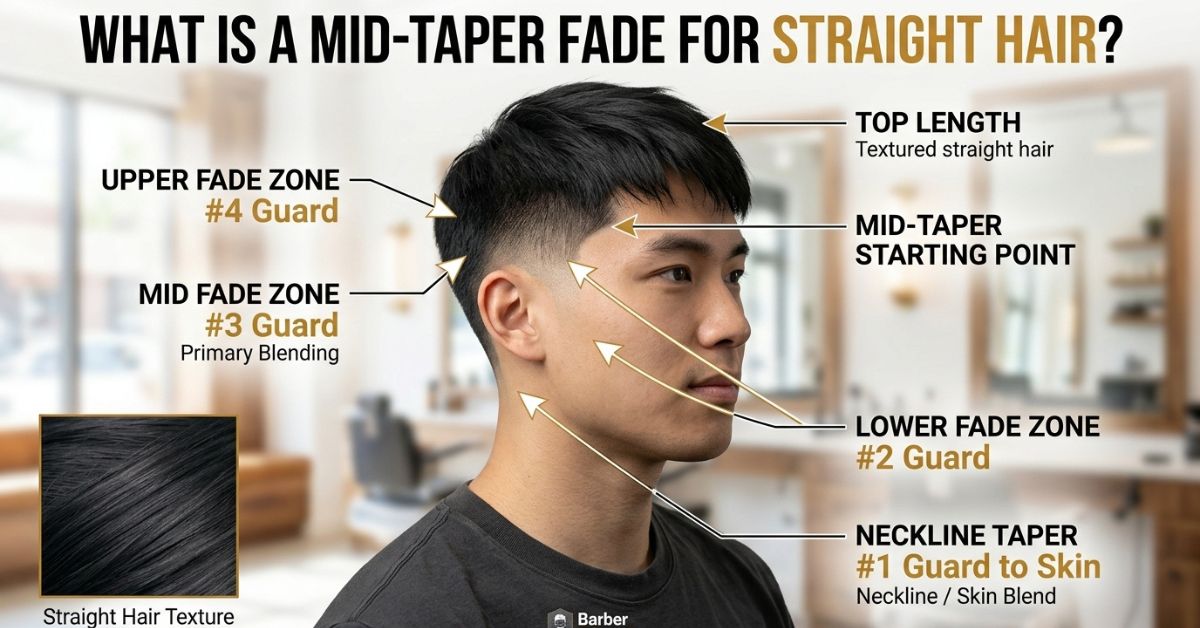
A mid-taper fade for straight hair is a men’s haircut where the sides and back get shorter in gradual steps. The blend begins at the temple level and ends at the neckline. The top stays longer.
Break the name into pieces:
- Mid: The blend starts around the temples.
- Taper: Length drops gradually instead of stopping abruptly.
- Fade: Clippers blend one length into the next with no visible line.
Barbers do draw a technical line here. According to The Art of Manliness, a taper keeps more length while a fade goes down to the skin. Most clients still say “mid taper fade” for a blend that starts at the temples. So give your barber guard numbers. A common setup runs from a #1 at the base up to a #3 or #4 before it meets the top.
Why Straight Hair Is Actually Perfect for a Mid Taper Fade
Straight hair works with this cut instead of against it. Here’s why:
- Line clarity: Smooth strands make fade lines look drawn with a ruler.
- Strong contrast: The long, sleek top plays off the short sides.
- Easy polish: You get a refined look without much effort.
- Styling range: Blow-dry it for lift, comb it flat, or pull it forward.
- Even growth: Straight hair grows downward in a uniform way, so the shape grows out predictably.
There’s a flip side, though. Straight hair also exposes sloppy blending. It can fall flat by lunchtime too. So the barber you choose and the product you pick both matter.
Mid Taper vs Low Taper vs High Taper – Which Is Best for Straight Hair?

Fade height changes the contrast, the upkeep, and the overall mood. Barber training materials usually place a low fade just above the ear, a mid fade at the temples, and a high fade near the parietal ridge.
| Feature | Low Taper | Mid Taper | High Taper |
|---|---|---|---|
| Starting point | Just above the ear | At the temples | Above the temples |
| Contrast | Subtle | Moderate to bold | Very bold |
| Touch-up timing | Every 3 to 4 weeks | Every 2 to 3 weeks | Every 1 to 2 weeks |
| Best for | Office settings | Almost any setting | Fashion-forward looks |
Low Taper Fade for Straight Hair
The low taper keeps things quiet. It shows less scalp, so it suits fine hair and conservative offices. Expect a subtle gradient that grows out gently.
Mid Taper Fade for Straight Hair
This is the sweet spot for most men. It looks polished at work and relaxed on weekends. If you’ve never worn a fade, start here. You can always go higher or lower next time.
High Taper Fade for Straight Hair
The high taper makes the biggest statement. It works best on thick hair that can support the contrast. However, it loses its edge fast, so plan on frequent visits.
25+ Best Mid Taper Fade Styles for Straight Hair in 2026

Each style below keeps the same mid taper sides. Only the top changes. Pick the one that fits your hair density, face shape, and daily routine.
1. Classic Mid-Taper Fade Straight Hair
This is the base cut. The sides taper from the temples while the top stays neat at about 2 to 3 inches. It needs very little product. Best for: oval, square, and heart faces.
2. Textured Fringe Mid-Taper Fade Straight Hair
Choppy layers fall forward over the forehead. They add the movement that flat hair lacks. Work in a pea-sized dab of matte clay. Best for: round, heart, and oval faces with medium to thick hair.
3. Messy Fringe Mid-Taper Fade Straight Hair
Think of this as the textured fringe with less effort. Rough dry with your fingers and add sea salt spray. The tidy sides keep the mess looking deliberate. Best for: oval, heart, and diamond faces.
4. Mid-Blowout Taper Fade Straight Hair
Dry the top up and back with a round brush for real height. The tight sides frame all that volume. Hit the cool shot button to lock the shape. Best for: oval and round faces. Fine hair needs mousse.
5. Curtain Bangs Mid Taper Fade Straight Hair
Center-parted bangs fall naturally to each side of the face. Straight hair cooperates without much product. Keep 4 to 6 inches on top. Best for: heart and oval faces.
6. Slick Back Mid Taper Fade Straight Hair
Comb everything back with a medium-hold pomade. The fade keeps the look modern instead of dated. It suits boardrooms and weddings equally well. Best for: square, oval, and diamond faces with medium to thick hair.
7. Comb-Over Mid-Taper Fade Straight Hair
A defined side part sweeps hair across the top. Straight strands keep the part line crisp. It works at nearly any age. Best for: oval, heart, and oblong faces.
8. Hard Part Mid Taper Fade Straight Hair
Your barber shaves a thin line into the part. That line adds a sharp accent to a classic cut. Ask for a fresh line at every visit. Best for: square, diamond, and oval faces with dense hair.
9. French Crop Mid Taper Fade Straight Hair
A short, blunt fringe sits across the forehead. Styling takes about three minutes. The forward direction also helps hide a thinning front. Best for: round, square, and heart faces.
10. Pompadour Mid Taper Fade Straight Hair
Volume sweeps up and back from the forehead. Build it with a round brush and finish with strong-hold pomade. You need medium to thick hair to hold the height. Best for: oval and oblong faces.
11. Mid Taper Fade for Asian Straight Hair
Dense hair with a strong downward growth pattern creates dramatic fade lines. Lift takes extra work, so press texture powder into the roots. Ask for a #0.5 base rather than a full skin fade for a softer hairline. Best for: all face shapes.
12. Mid Taper Fade for Thin Straight Hair
Keep a #1 guard as the minimum at the base. Leave 3 to 4 inches on top. Use mousse before drying and powder after. Choose a textured or messy fringe to fake thickness. Best for: oval and heart faces.
13. Mid Taper Fade for Thick Straight Hair
Thick hair holds fade lines the longest. Ask your barber to point-cut the top so it doesn’t sit like a helmet. A strong-hold clay handles the density. Best for: every face shape.
14. Disconnected Mid Taper Fade Straight Hair
There’s no gradual blend between the top and the sides. A visible line separates them. Push the top up or back to show it off. Best for: oval and diamond faces in creative workplaces.
15. Edgar Cut Mid Taper Fade Straight Hair
A blunt, horizontal fringe cuts straight across the forehead. Thick hair supports that geometric edge best. Trim the fringe between visits. Best for: square and round faces.
16. Crew Cut Mid-Taper Fade Straight Hair
Short and disciplined, the crew cut stays under about 2 inches on top. You can skip product altogether. It’s gym-friendly and job-interview-friendly. Best for: all face shapes.
17. Quiff Mid Taper Fade Straight Hair
Hair lifts at the front and sweeps slightly back. Dry upward with a vent brush. Then lock it with matte clay. Best for: round and square faces.
18. Ivy League Mid Taper Fade Straight Hair
This is a longer crew cut with a soft side part. Light pomade adds shine without stiffness. It looks neat but never fussy. Best for: oval and oblong faces.
19. Side Part Mid Taper Fade Straight Hair
Part the hair while it’s damp. Then smooth it across with a medium-hold pomade. It’s the most flexible option on this list. Best for: all face shapes.
20. Faux Hawk Mid Taper Fade Straight Hair
A center strip of height runs from forehead to crown. Fiber paste keeps it flexible instead of rigid. It’s bold but still wearable. Best for: oval and diamond faces.
21. Spiky Top Mid Taper Fade Straight Hair
Short spikes, about 1 to 2 inches long, add playful energy. Straight strands hold their points cleanly. Use gel or wax on slightly damp hair. Best for: round and oval faces.
22. Caesar Cut Mid Taper Fade Straight Hair
A short fringe of even length sits forward. It also softens a receding hairline. Daily styling takes almost no time. Best for: round and square faces.
23. Mid Taper Fade with Beard: Straight Hair
Blend the fade into the beard at the sideburn and cheek line. Avoid a hard break between hair and beard. Short to medium beards work best. Beard oil keeps the transition soft. Best for: square, oval, and round faces.
24. Long Top Mid Taper Fade Straight Hair
Four to six inches on top gives you options. Wear it forward, back, or to the side. Thin hair can look wispy at this length. Best for: oval and oblong faces.
25. Modern Mullet Mid Taper Fade Straight Hair
The front and sides stay short while the back runs longer. Tight tapered sides keep it looking current. Sea salt spray adds flow to the back. Best for: oval and heart faces.
How to Style Mid Taper Fade Straight Hair: Step-by-Step
Good technique beats heavy product every time. Follow this order for any of the styles above.
Daily Styling Routine for Mid-Taper Fade Straight Hair
- Towel dry gently. Squeeze out water instead of rubbing. Aim for 70 to 80 percent dry.
- Add a pre-styler. Use mousse for fine hair or a light cream for thicker hair.
- Blow-dry in the style’s direction. Hold the dryer about 6 inches away on medium heat.
- Shape while warm. Hair sets as it cools, so direct it with your fingers right away.
- Finish with clay or cream. Start with a pea-sized amount. Add more only if you need it.
- Check the details. Smooth the sides and piece out the fringe.
Blow-Drying Technique for Volume on Straight Hair
Switch to a round brush for lift. Roll it from root to tip while the dryer points upward. Finish with the cool shot to set the shape. Volumizing mousse applied beforehand adds body without weight.
Creating Texture on Naturally Flat Straight Hair
Flat hair usually needs the right product more than extra effort. Sea salt spray on damp hair builds grip. Texture powder on dry roots adds lift. Matte clay creates separation. Skip petroleum-heavy pomades because they coat the strands and drag them down.
Styling for Different Occasions
- Work: Blow-dry smooth, add light pomade, and comb neatly.
- Weekend: Rough dry, spritz sea salt spray, and tousle.
- Date night: Blow-dry for volume, then work in matte clay.
- Formal event: Slick back with medium-hold pomade and a crisp part.
Best Products for Mid Taper Fade on Straight Hair
Straight hair gets weighed down quickly. Choose water-based or matte formulas, and use less than you think you need.
Best Matte Clays for Straight Hair
- Hanz de Fuko Claymation: Strong hold for thick hair.
- Uppercut Deluxe Matte Clay: Medium-strong hold with a natural finish.
- Reuzel Clay Matte Pomade: Lightweight enough for fine hair.
Best Styling Creams for Straight Hair
- Layrite Matte Cream: Flexible hold for fringes and messy looks.
- Jack Black Texture Cream: Adds body without crunch.
Best Texture and Volume Products for Straight Hair
- Moroccanoil Volumizing Mousse: Pre-dry lift for flat hair.
- Bumble and Bumble Surf Spray: Beachy grip on damp hair.
- Texture powder: Instant root lift on dry hair.
| Product | Best for | Hold | Finish |
|---|---|---|---|
| Matte clay | Thick hair | Strong | Matte |
| Styling cream | All hair types | Light to medium | Natural |
| Mousse | Fine, flat hair | Light | Natural |
| Pomade | Slick back, comb over | Medium to strong | Shiny |
Which Face Shape Suits a mid-taper fade straight hair best?
The fade flatters almost everyone. Your top style does the real face-shaping work.
Oval Face Shape
You can wear anything here. Oval faces have balanced proportions, so choose by lifestyle instead of limits.
Round Face Shape
Go for height. A quiff, blowout, or textured fringe adds vertical lines and makes the face look longer.
Heart Face Shape
Curtain bangs and messy fringes soften a wide forehead. Medium-length tops keep proportions even.
Square Face Shape
Strong jaws carry sharp cuts well. Comb-overs, side parts, and the Ivy League add a softer touch. A hard part leans into the angles.
Diamond Face Shape
A side part or faux hawk adds width at the crown. That balances prominent cheekbones.
Mid Taper Fade for Thin vs Thick Straight Hair: Key Differences
Hair density changes your instructions to the barber.
Thin Straight Hair: What to Do Differently
- Keep a #1 guard minimum so the scalp doesn’t glare through.
- Leave 3 to 4 inches on top.
- Use mousse and powder instead of oily products.
- Pick textured or messy fringes for visual thickness.
Thick Straight Hair: What to Do Differently
- Ask for point-cutting or texturizing to remove bulk.
- Use a strong-hold clay because light products can’t control the density.
- Expect bold fade lines that last longer between visits.
How to Ask Your Barber for a Mid Taper Fade on Straight Hair
Clear words prevent bad haircuts. Say this:
“I’d like a mid taper fade starting at my temples. Please use a #1 at the base and blend up to a #3. Keep about [X inches] on top, styled [forward, back, or textured].”
Then add these details:
- Bring front and side reference photos.
- Describe your hair as fine, medium, or thick.
- Say whether you want a skin fade or a #0.5 base.
- Ask how often you should return.
Watch for red flags. A good barber consults first and blends slowly. They can explain their guard progression. A proper mid taper usually takes 30 to 45 minutes.
Mid Taper Fade Maintenance Schedule and Growth Timeline
Hair grows roughly half an inch per month. In three weeks, that’s about three-eighths of an inch. On straight hair, that’s enough to blur the blend.
Professional Touch-Up Schedule
- Every 2 weeks: Maximum sharpness.
- Every 2 to 3 weeks: The best balance for most men.
- Every 3 to 4 weeks: The fade starts to soften.
- After 4 weeks: You need a full re-cut.
Week-by-Week Growth Timeline
- Week 1: Peak sharpness with crisp lines.
- Week 2: Still clean with slight softening at the base.
- Week 3: The blend blurs and the top runs long.
- Week 4: Overgrown. Book a full cut.
Between-Visit Home Maintenance
- Clean the neckline with a basic trimmer.
- Use clarifying shampoo once a week to remove buildup.
- Never touch the fade line yourself.
Common Mistakes to Avoid with Mid Taper Fade on Straight Hair
- Skin fading thin hair. It exposes the scalp and looks patchy.
- Guessing the fade height. Start at mid and adjust later.
- Using heavy pomades. They leave straight hair greasy and limp.
- Skipping product. Straight hair loses direction fast.
- Overloading product. Pea to dime size is plenty.
- Waiting too long. Growth shows quickly on flat hair.
- Skipping reference photos. “A little shorter” means different things to different barbers.
How Much Does a Mid Taper Fade for Straight Hair Cost?
Prices vary by city and shop. These ranges reflect typical U.S. barbershops.
| Service | Typical price | Includes |
|---|---|---|
| Basic barbershop | $25 to $40 | Cut and fade |
| Mid-range shop | $40 to $60 | Cut, fade, and styling |
| Premium salon | $60 to $100+ | Consultation, cut, product |
| Touch-up | $20 to $35 | Fade and neckline refresh |
Expect 30 to 45 minutes for a full cut. Touch-ups take 20 to 30 minutes. Daily styling takes 5 to 10 minutes once you learn your routine.
Frequently Asked Questions
Is a mid-taper fade good for straight hair?
Yes. Straight hair shows the blend more clearly than any other texture. That makes the gradient look sharper.
How often should I get a mid-taper fade touched up?
Every 2 to 3 weeks. After that, the blend starts to blur.
What products work best for a mid taper fade on straight hair?
Use matte clay for thick hair, light cream for fine hair, and volumizing mousse for flat hair. Avoid heavy petroleum-based pomades.
What’s the difference between a mid taper and a low taper for straight hair?
A mid taper starts at the temples and looks bolder. A low taper starts above the ear and looks subtler.
What face shapes suit a mid taper fade best?
It flatters every shape, especially oval, round, and heart. Adjust the top style to balance your proportions.
Can I get a mid taper fade on thin straight hair?
Yes. Keep a #1 guard at the base, leave 3 to 4 inches on top, and use volumizing products.
How do I style a mid taper fade for volume on straight hair?
Apply mousse, blow-dry upward with a round brush, and finish with texture powder or matte clay.
What exactly do I say to my barber?
Ask for a mid taper fade at the temples with a #1 base blending to a #3. Specify your top length and bring photos.
Will a mid-taper fade look good as it grows out on straight hair?
It looks good for about 2 to 3 weeks. After that, straight hair shows the growth clearly.
What’s the difference between a taper and a fade for straight hair?
A taper shortens gradually and keeps more length. A fade blends down to skin or very short stubble.
Final Thoughts
A mid taper fade gives straight hair structure without making it stiff. It works in an office, at a wedding, and on a Saturday night. The cut only needs three things from you: clear barber instructions, light product, and a touch-up every two to three weeks.
Pick one style from the list. Screenshot it. Then walk into your next appointment with the script above.

Marco Silva is a fashion writer and content creator at Faxhion Purly, sharing practical insights on clothing, styling, fashion trends, and personal style. With a focus on research and clear communication, Marco creates reader friendly articles designed to help fashion enthusiasts discover useful ideas, understand trends, and make informed style choices.