

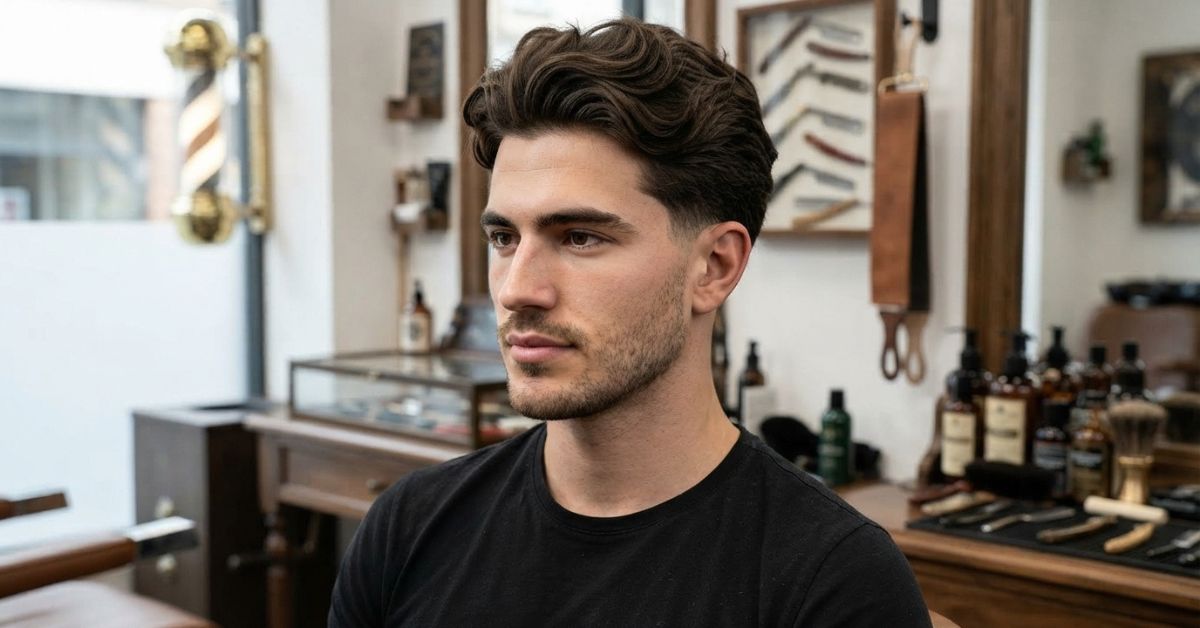
A mid blowout taper is one of the most requested men’s cuts right now, and it is easy to see why. It looks sharp, feels relaxed, and works in an office or on a weekend. But many guys leave the chair with a result that looks nothing like the photo they brought in.
The reason is usually simple: the request was vague. This guide explains what the cut is, how it looks on each hair texture, and what to say to your barber. You will also find a step-by-step blow-dry routine, a grow-out timeline, and the mistakes that ruin the shape.
What Is a Mid Blowout Taper?
A mid blowout taper is a men’s haircut with a taper that starts at the temple and a longer top that is blow-dried up and back for volume. The taper cleans up the sides and neckline. The blowout gives the top its lift and movement.
Think of it as two parts working together:
- The perimeter: short, gradual tapering around the temple, ear, and neckline.
- The top: enough length, usually 3 to 5 inches, to be styled with a dryer and brush.
The “mid” is the height of the taper. It sits between a low taper, which starts near the top of the ear, and a high taper, which starts above the temple. That middle position is why barbers often recommend it to first-timers.
Taper vs. Fade: What Is the Difference?
People mix these terms up all the time, and the confusion is fair. A taper shortens hair gradually in a narrow band and leaves most of the sides at a wearable length. A fade removes much more hair and often goes down to the skin.
A taper grows out more evenly because less hair is taken off. It also gives you a softer look. If you want to keep some skin-level contrast, ask about it separately, because that is a different cut.
Where Does the Taper Actually Start?
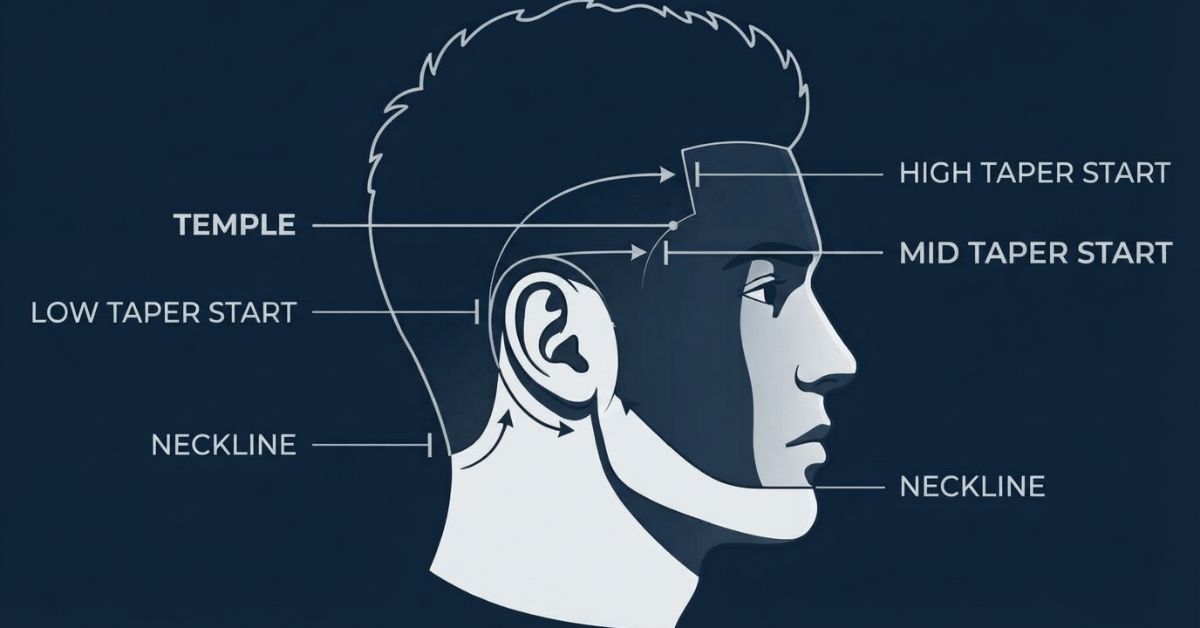
The taper starts at the temple, roughly halfway between your front hairline and your ear. From there it follows a clear path:
- Temple — the taper begins here, at the widest part of your head above the ear.
- In front of the ear — the taper continues down, staying tight against the hairline.
- Behind the ear and sideburn — the taper blends into the sideburn area.
- Neckline — the taper finishes with a clean neckline cleanup.
If your barber starts higher than the temple, you get a high taper. If they start near the ear, you get a low one. Naming the temple as the starting point removes most of the guesswork.
What Does a Mid Blowout Taper Look Like?
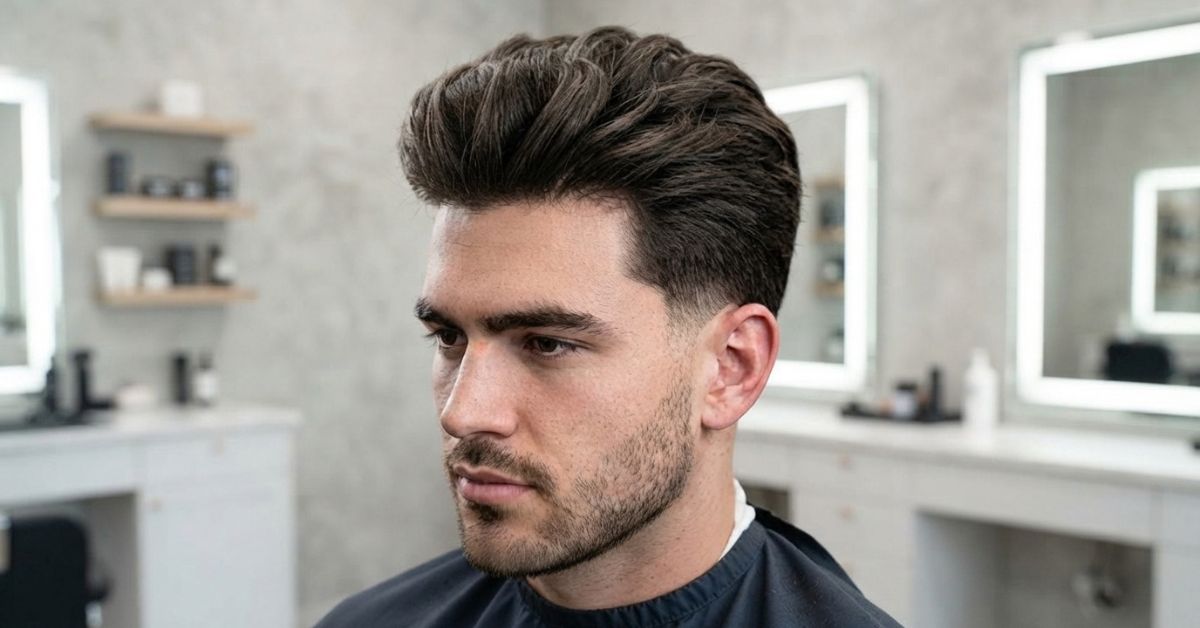
A mid blowout taper has a full, soft, textured top that sits above sides that tighten evenly toward the neck. The contrast between the two is what makes the cut look intentional.
The top does not lie flat. It lifts at the front and crown and moves when you touch it. The sides stay clean, so the whole shape reads as styled rather than just grown out.
Here is a quick visual checklist:
- Volume at the front and crown
- Visible texture, not a solid helmet of hair
- A smooth gradient with no hard line or “shelf” at the sides
- A tidy neckline that matches your hair type
Read More : High Blowout Taper Haircut Guide: Low vs. Mid vs. High for Every Hair Type
What Are the Mid Blowout Taper Variations?
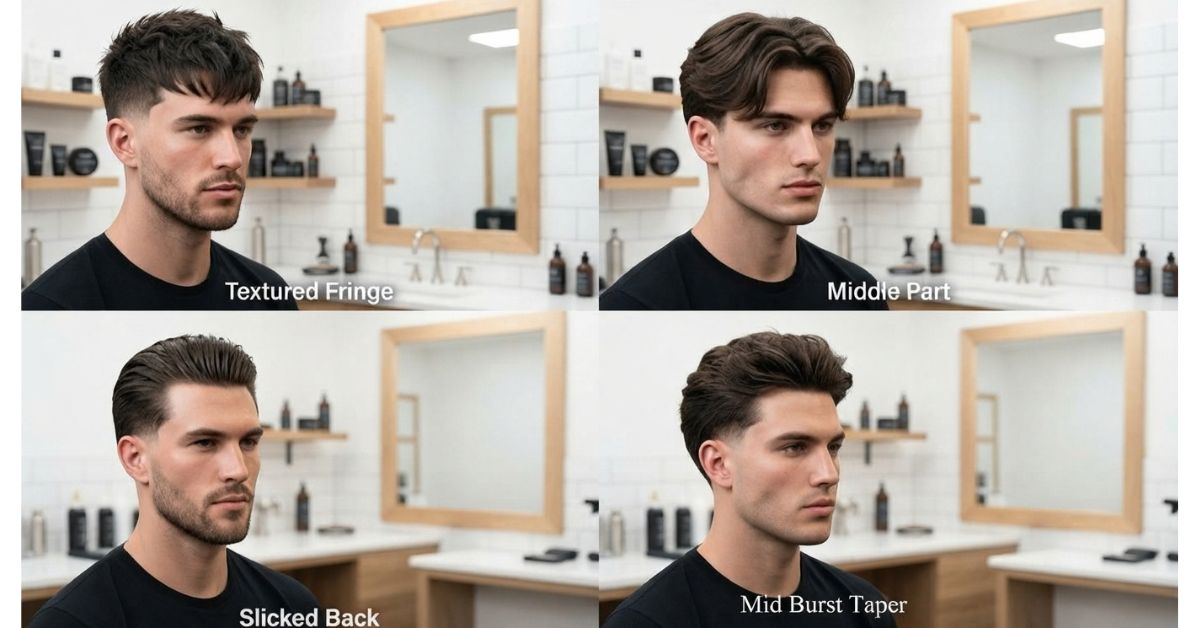
The taper stays the same in every version. What changes is how you cut and style the top. These four are the most popular.
Adding a Textured Fringe
A textured fringe pushes the front forward in broken, piecey strands instead of one straight line. You need about 3 to 4 inches of length at the front so the dryer can separate the hair.
Ask your barber to point-cut the ends. This removes bulk and keeps the fringe from looking like a solid curtain. It suits guys who want a relaxed, slightly undone finish.
Adding a Middle Part
A middle part splits the top down the center, and each side is dried outward and slightly up. It works best when your hair has some natural bend or wave.
Very straight hair can fall flat at the part. Blow-dry the roots upward first to build support underneath, then place the part last.
The Slicked-Back Version
Slicking the top straight back gives a sharper, more polished look. The tight mid taper keeps the shape from looking bulky.
Use a light-hold product so the shine looks natural. Heavy pomades pull the top down and lose the blowout effect.
The Burst Taper Variation
A burst taper curves around the ear instead of running in a straight line. It creates a rounded shape at the base of the sideburn.
In the mid version, that curve stays higher on the head than it would on a drop fade. It adds detail without making the cut look aggressive.
How Do You Ask Your Barber for This Cut?
Give your barber three things: the taper height, the top length, and how you plan to style it. Words like “clean it up” or “just a taper” leave too much room for interpretation.
Here is a script that works in most shops:
“I’d like a mid blowout taper. Start the taper at the temple, wrap it around the ear and neckline, and keep about four inches on top with texture so I can blow-dry it up and back. Nothing bald at the edges.”
Say the word “blowout” out loud. It tells the barber to leave length pointing up and back instead of cutting the top short and flat.
Add Numbers and a Photo
Guard numbers remove doubt. Clipper guards run from a bare blade or #0 at the tightest point up to a #2 in the blend zone, and scissors handle the top. If you want to avoid skin, ask for a #1 or #0.5 at the shortest point.
Bring a reference photo too, ideally one from the side and one from the back. A front-only photo hides the neckline, which is where many misunderstandings happen.
Read More: 35 Best Mid Taper Fade Styles for Black Men (2026 Guide)
Natural Edge or Sharp Edge-Up?
A sharp edge-up gives a crisp, geometric hairline that looks great on day one. It also softens quickly, often within a week.
A natural edge looks softer from the start and grows out more gracefully.
- Choose the sharp edge-up for events, photos, or if you like a precise look.
- Choose the natural edge if you want less upkeep.
Consultation or Walk-In?
If this is your first mid blowout taper, take two minutes to talk it through before the clippers start. Confirm the taper height, top length, and edge style.
If you already have the cut, you can usually walk in and say “same as last time.” Showing a photo of your last cut helps even more.
Quick pre-cut checklist:
- Taper starts at the temple
- Top length in inches
- Point-cut or textured top
- Natural or sharp edge
- Neckline shape
Does This Haircut Work With Your Hair Type?
Yes, the mid blowout taper works on every major texture. The cutting method and styling routine change depending on your hair.
Straight Hair
Straight hair needs texture cut into it. If the top is cut blunt, the dryer has nothing to grip and the hair falls flat.
Barber script: “Mid blowout taper, point-cut the top so it isn’t blunt. I need texture so the blow-dry holds.”
Wavy Hair
Wavy hair has natural movement, so the blowout takes less effort. Apply a light sea salt spray to damp hair, then dry with a diffuser or lift the roots with a brush. The waves add body without much work.
Curly Hair
Curls hold vertical volume well, but they shrink as they dry. Depending on curl pattern, the shrinkage can be large, so a wet cut may end up much shorter than planned.
Barber script: “Mid blowout taper. Cut the top dry or stretched so we don’t lose length, and keep at least four inches when stretched.”
Coily Hair
Coily hair holds a lifted, structured shape at the crown better than most textures. It also shrinks the most, so the same dry or stretched cutting rule applies.
A tapered afro with a mid taper is a natural fit. It keeps the shape clean while the top stays full.
Fine or Thin Hair
Fine hair usually looks better with a low or mid taper than a high one. A high taper exposes more of the sides, which makes the difference in density between the top and sides more obvious.
The mid height keeps attention on the volume up top. A volumizing mousse and a cool-air finish help the top hold.
Which Face Shapes Suit It Best?
- Round faces: The mid height adds structure without exposing extra width.
- Square faces: It softens the jaw and keeps the outline balanced.
- Long faces: The fuller sides keep the face from looking stretched.
- Oval faces: Almost any version works, so choose based on style.
How Do You Style This Cut at Home?
Styling a mid blowout taper takes about five to ten minutes once you learn the routine. The blowout part happens at your bathroom mirror, not in the barber’s chair.
Step-by-Step Blow-Dry Routine
- Start with damp hair, not soaking wet and not fully dry.
- Apply a pre-styler such as mousse, sea salt spray, or curl cream, depending on your texture.
- Rough-dry the roots by lifting the hair up and forward with your fingers.
- Use a round brush to pull the front section up and back while drying.
- Finish with a cool-air blast for about ten seconds to set the shape.
- Add a matte product to the ends only, so the roots stay light.
Match Your Product to Your Hair Type
| Hair Type | Best Product | Why It Works | When to Apply |
|---|---|---|---|
| Fine or straight | Volumizing mousse | Adds lift without weight | Damp hair, before drying |
| Thick or straight | Texture clay | Medium hold with a matte finish | Dry hair, after drying |
| Wavy | Sea salt spray | Defines natural texture | Damp hair, before diffusing |
| Curly | Curl cream | Controls frizz and defines curls | Wet hair |
| Coily | Curl cream and diffuser | Holds shape and reduces frizz | Wet hair |
A simple test: run your fingers through the top. If you feel clumps, you used too much. Product that sits on top of the hair makes volume collapse faster.
How Long Between Touch-Ups?
Hair grows about half an inch per month on average, according to the American Academy of Dermatology. That pace sets your schedule.
| Hair Type | Edge and Neckline Touch-Up | Full Cut |
|---|---|---|
| Straight | About 2 weeks | 3 to 4 weeks |
| Wavy | About 2 weeks | 3 to 4 weeks |
| Curly or coily | 2.5 to 3 weeks | 3 to 4 weeks |
Straight hair shows grow-out first because the sides lie flat. Curly and coily textures hide it a little longer. Sharp edge-ups soften faster than natural edges.
What grow-out looks like:
- Week 1 to 2: The taper looks crisp.
- Week 3: The gradient softens and the sides start to fill in.
- Week 4 or later: The shape loses definition and the top gets heavy.
If you live in a humid place, expect the top to lose shape sooner. A light-hold finishing spray helps.
Mid vs. Low vs. High Taper: Which Wins?
The mid taper is the most versatile choice for most people. It sits between the low taper’s subtlety and the high taper’s boldness.
| Feature | Low Taper | Mid Taper | High Taper |
|---|---|---|---|
| Starts at | Just above the ear | The temple | Above the temple |
| Contrast | Subtle | Balanced | Bold |
| Grow-out | Blends in fastest | Holds shape longer than low | Shows growth most |
| Best for | Most face shapes | Round, square, long faces | Oval faces or extra height |
| Workplace fit | Most conservative | Professional-friendly | Least conservative |
Choose the low version if you want a barely-there look. Choose the high version if you want maximum contrast. If you are unsure, start with mid. You can always go higher next time, but you cannot add hair back.
Common Mid Blowout Taper Mistakes to Avoid
A few predictable errors cause most disappointing results.
- The mushroom effect: The sides flare out because too little weight was removed. Ask your barber to remove weight, not only length.
- Volume collapsing by afternoon: This comes from too much product or too little top length. Keep at least 3 inches and use less styler.
- A taper that looks like a fade: Too much hair came off in the taper band. Confirm the temple-to-neckline path before cutting.
- Curly hair cut too short: The barber cut it wet and ignored shrinkage. Ask for a dry or stretched cut.
- Starting too high: This turns the cut into a high taper and changes the whole look.
- Skipping the back view: Always check the neckline in a hand mirror before you pay.
If the cut comes out wrong, don’t panic. Go back within a week and explain what is off, such as “the taper starts too high” or “the top is too short.” Most barbers will adjust it, and it is easier to fix the sides than the top.
Frequently Asked Questions
What is the difference between a mid blowout taper and a mid taper fade?
A mid blowout taper uses a narrow, gradual taper and a long, blow-dried top. “Mid taper fade” is often used loosely for the same cut, though a true fade removes more hair.
How long should hair be on top for a mid blowout taper?
Aim for at least 3 inches, and 4 to 5 inches is better. Shorter hair cannot lift into real volume.
Does a mid blowout taper work on thin or fine hair?
Yes. Choose a mid or low taper instead of a high one, and use a light mousse to build lift.
How often should you get a touch-up?
Book an edge and neckline cleanup every 2 to 3 weeks and a full cut every 3 to 4 weeks. Curly and coily hair can often go a little longer.
Should you choose a natural edge or a sharp edge-up?
Pick a sharp edge-up for a crisp look that lasts about a week. Pick a natural edge for a softer look that needs less upkeep.
How much should you tip for a blowout taper?
In the US, 15 to 20 percent is standard, according to the Emily Post Institute. Adjust for your region and your satisfaction.
Can you get a mid blowout taper with a beard?
Yes. Blend the taper into the sideburn and beard line so there is no gap or hard edge.
Read More: Blowout Taper Textured Fringe – Low, Mid & High: What to Ask For and How to Style It
Key Takeaways
- A mid blowout taper starts the taper at the temple and keeps 3 to 5 inches on top for a blow-dried finish.
- It works on straight, wavy, curly, and coily hair, and it flatters round, square, and long faces.
- Tell your barber the taper height, top length, texture, and edge style, and bring front, side, and back photos.
- Ask for a dry or stretched cut if your hair is curly or coily.
- Match your product to your texture and use less than you think you need.
- Plan a neckline touch-up every 2 to 3 weeks and a full cut every 3 to 4 weeks.
Walk in with a clear script, and the mid blowout taper is one of the easiest cuts to get right. If you are still deciding, start at the mid height, then adjust after your first cut.

Marco Silva is a fashion writer and content creator at Faxhion Purly, sharing practical insights on clothing, styling, fashion trends, and personal style. With a focus on research and clear communication, Marco creates reader friendly articles designed to help fashion enthusiasts discover useful ideas, understand trends, and make informed style choices.