

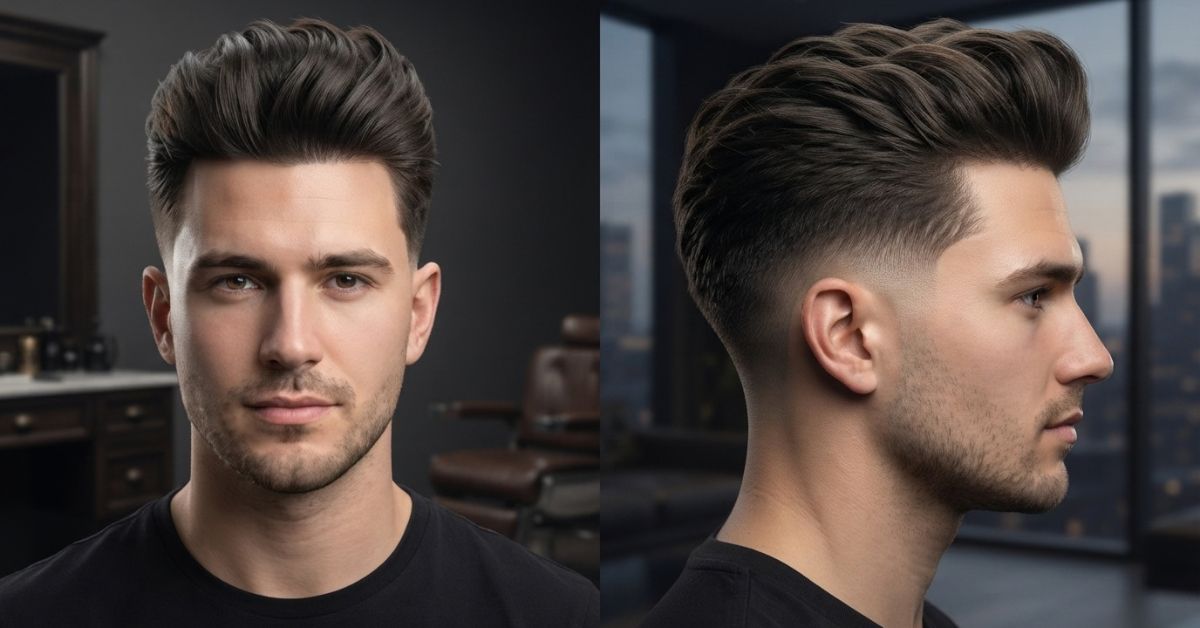
A high blowout taper is a men’s haircut where the taper starts above the temples, sitting higher than a low or mid taper, while the top stays long enough to blow-dry into full, lifted volume. It can work especially well with round and oval face shapes and usually needs a trim every two to three weeks to keep its clean, defined look.
This guide explains exactly where a high taper starts, which face shapes and hair textures can suit the style, and what to tell your barber before the clippers come out. You’ll also learn how long it can take to grow your hair to blowout-ready length, how to choose a taper based on your face shape, and which common mistakes can leave the finished cut looking uneven. Each section focuses on practical questions you may have before getting a high blowout taper.
Quick Answer: What Is a High Blowout Taper?
A high blowout taper is a haircut where the fade begins above the temple, near the widest point of the skull, while the top is left long enough (roughly two to three inches) to blow-dry into full, lifted volume. It’s the boldest of the three taper heights, best suited to round, oval, and diamond face shapes, and it needs a trim every two to three weeks to stay sharp.
- Fade starts above the temple, not at it
- Top length: 2 to 3 inches minimum for real lift
- Best on round, oval, and diamond faces
- Highest-maintenance of the three taper heights
What Is a High Blowout Taper?
A high blowout taper combines two separate decisions: how high the fade climbs up the side of the head, and how much length gets left on top for styling. The “taper” part refers to the gradual shortening on the sides and neckline. The “blowout” part refers to what happens next, blow-drying that longer top upward and outward with a round brush or diffuser until it holds a rounded, voluminous shape.
Because these are two independent choices, you can technically ask for a high fade with a short, textured top, or a high taper with a full blowout finish, and get very different results from the same starting height. That’s the single most common mix-up guys run into at the barbershop.
Taper vs. Fade: What’s the Difference?
A taper only shortens hair near the edges: the sideburns, behind the ears, and along the neckline, while leaving noticeably more length above that zone. A fade blends much higher up the scalp and exposes skin along a longer stretch of the head.
In casual conversation, “taper” and “fade” get used interchangeably, but a true taper never touches skin and grows out far more gracefully than a fade does. If your goal is a cut that still looks presentable at the four-week mark, a taper holds its shape longer than a comparable fade.
Where Does the “High” in a High Taper Start?
The fade line on a high taper begins above the temple, close to the parietal ridge, the widest and highest curve of the skull before it slopes into the crown. This is a fixed anatomical landmark, so it gives your barber a consistent reference point regardless of your hair density or curl pattern.
A mid taper starts roughly at the temple itself, and a low taper stays down near the ears and neckline. That few inches of difference is what separates a subtle cut from a high-contrast one.
Is a High Fade the Same as a High Blowout Taper?
No. Both can start at the same height on the head, but a high fade usually finishes with a short, textured top, while a high blowout taper leaves the top long specifically so it can be blow-dried into volume. If you only ask for “a high fade,” you risk walking out with far less length on top than you wanted.
Read More: 35 Best Mid Taper Fade Styles for Black Men (2026 Guide)
High vs. Low vs. Mid Blowout Taper
Each taper height changes three things at once: how much contrast you get, how often you need a trim, and which face shapes it flatters. Here’s how they stack up side by side.
| Attribute | Low Taper | Mid Taper | High Taper |
|---|---|---|---|
| Fade starts | Neckline and ears | Around the temples | Above the temples |
| Contrast | Subtle | Balanced | Sharp, high-contrast |
| Best face shapes | Long, oblong | Most shapes | Round, oval, diamond |
| Trim frequency | Every 3 to 4 weeks | Every 2 to 3 weeks | Every 2 to 3 weeks, cleanup at 10 to 14 days |
| Dress-code friendly | Very | Mostly | Depends on the workplace |
High Blowout Taper
The high blowout taper starts its taper above the temple line and delivers the sharpest visual break between the sides and the top. It reads as intentional and styled rather than “just grown out,” which is why it’s popular in creative fields, on social media, and among guys who don’t mind a barbershop visit every couple of weeks.
Because so much scalp shows through the shortened sides, small irregularities in head shape, flat spots or bumps, become more visible at this height. It’s worth mentioning that to your barber if you’ve had trouble with fades looking uneven in the past.
Low Blowout Taper
A low blowout taper keeps the shortening confined to the neckline and around the ears, leaving the bulk of the side hair intact. It’s the lowest-maintenance option of the three, since regrowth along the ears and neck is far less noticeable than regrowth higher up the head.
This height also works best for long or oblong face shapes, since it doesn’t add extra vertical volume that would stretch the face further.
Mid Blowout Taper
The mid blowout taper splits the difference, starting around the temple itself rather than above or below it. It’s the most versatile of the three, flattering nearly every face shape while still giving a noticeably fresher look than a low taper.
If you’re not sure which height to ask for, the mid taper is the safest starting point. It’s easier to go higher at your next visit than to fix a cut that went too aggressive the first time.
Which Taper Height Is Right for You?
Match the height to three factors: how often you’re realistically willing to sit in a barber’s chair, how conservative your workplace dress code is, and how much contrast you actually want. A finance or client-facing job usually pairs better with a low or mid taper, while creative and tech environments tend to have more room for a high taper’s bolder look.
What Does a High Blowout Taper Look Like?
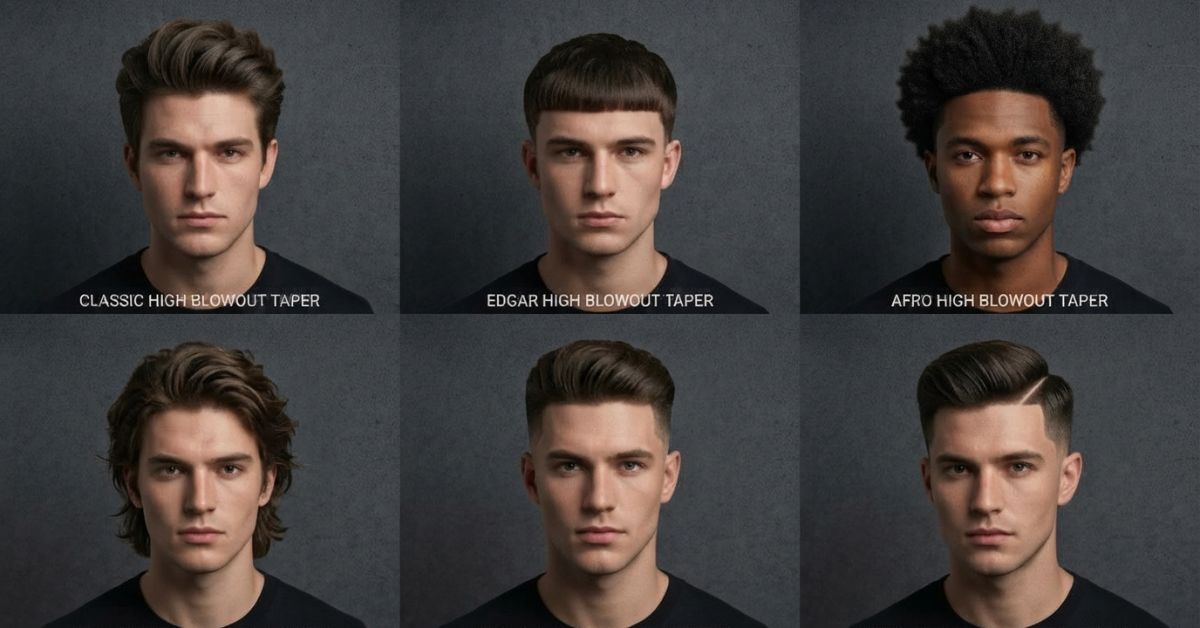
A high blowout taper looks different depending on how the top is textured, parted, or layered, but every version shares the same tight, high fade on the sides. Below are the most requested variations.
- Classic High Blowout Taper — A rounded, evenly lifted top with no fringe or part, styled straight up and back.
- High Blowout Taper Edgar — A straight, sharp fringe across the forehead paired with the tapered sides, giving a bolder, more structured look.
- Afro High Blowout Taper — Natural curls left long on top for volume, with the high taper controlling bulk around the ears and neckline.
- High Blowout Taper with Fringe — Movement and texture on top with a soft fringe piece falling forward, paired with a clean high taper.
- High Blowout Taper Mullet — A voluminous front and crown combined with longer, layered hair at the back, with the taper keeping the sides sharp.
- Temple Blowout Taper — The fade focuses tightly around the temples and sideburns while the back stays natural or lightly tapered.
- High Blowout Taper Wolf Cut — Shaggy, layered chaos on top paired with clean, high-contrast sides.
- Blowout Perm Taper Fade — Soft curls or waves added through a perm, styled up and out, with a high taper underneath.
- High Blowout Taper with Skin Fade Sides — The sides taken down to skin for maximum contrast against the voluminous top.
- High Blowout Taper with Hard Part — A shaved line dividing the top from the taper, adding a sharper visual break.
What Beard Styles Pair Best With a High Taper?
A clean shave or light stubble keeps the visual focus on the height of the cut without adding competing width at the jaw. A short, boxed beard also works well, since its clean lines echo the sharpness of the fade. A full, rounded beard tends to work against the proportions a high taper is trying to create.
Does a High Blowout Taper Suit All Hair Types?
A high blowout taper works across straight, wavy, curly, and coily hair, but each texture needs a different amount of effort to hold the shape through the day. The Andre Walker Hair Typing System classifies hair from Type 1 (straight) through Type 4 (coily), and where your hair falls on that scale largely determines your styling routine.
High Blowout Taper for Straight Hair
Straight hair naturally wants to lie flat, so it depends entirely on the blow-dry step for lift. Texture needs to be cut into the top layers first, and a volumizing mousse applied to damp hair before drying gives the round brush something to grip.
High Blowout Taper for Wavy Hair
Wavy hair holds a blowout shape with the least daily effort of any texture, since the natural bend already pushes the hair up and away from the scalp. A light curl cream is usually enough to define the shape without weighing it down.
High Blowout Taper for Curly Hair
Curly hair retains strong volume once styled, and a diffuser attachment works better here than a round brush, since it dries the curl pattern in place rather than pulling it straight. Curl cream applied to damp, scrunched hair locks in definition.
High Blowout Taper for Coily Hair
Coily and Afro-textured hair holds its shape the longest between cuts and can carry noticeable weight on top without losing its silhouette. A leave-in cream followed by a light-hold gel, applied section by section, gives the most even result.
How Long Does Hair Need to Grow Before a Blowout Taper?
Hair on top generally needs to reach about two to three inches before a blow-dry can create real volume. According to the American Academy of Dermatology, scalp hair grows at an average rate of roughly half an inch per month, so growing out from a short fade to blowout-ready length typically takes three to four months of consistent growth.
Does Your Face Shape Fit a High Taper?
Adding height on top changes how long or wide your face appears, which is why some face shapes suit a high taper far better than others.
Best Face Shapes for a High Taper
- Round: the added height elongates the face and breaks up its natural width
- Oval: naturally balanced proportions suit any taper height, including high
- Diamond: accentuates the cheekbones without adding extra width at the jaw
Read More: Mid Taper Fade Curly Hair: 15 Best Styles for Men (2026)
How to Adjust the Cut for Your Face Shape
Square faces can wear a high taper, but the sharp contrast can emphasize jaw width, so asking for a slightly softer blend helps balance it out. Long or oblong faces generally look better in a low or mid taper instead, since extra vertical volume on an already long face tips the proportions too far in one direction.
What Do You Tell Your Barber?
Specific language about fade height, top length, and the transition zone is what separates a sharp result from an uneven one. A script that covers all three points works better than a general description:
“I’d like a high blowout taper. Start the fade above the temples, blend it smoothly into the skin near the ears and neckline, and leave at least two to three inches on top so I can blow it out.”
Which Clipper Guard Should You Ask For?
| Skull Position | Typical Guard or Technique |
|---|---|
| Neckline | Guard 0, skin or near-skin |
| Near the ear | Guard 1 |
| Mid-side, below the fade line | Guard 2 to 3 |
| Above the temple, blending into top | Scissor-over-comb or clipper-over-comb |
What Should You Never Say to Your Barber?
Avoid vague phrases like “taper it up” without naming a specific height, since that means something different to every barber. Also avoid asking for “a high fade” if what you actually want is the longer, blow-dryable top, and never skip mentioning your desired top length, since that’s the detail most likely to get shortened by mistake.
How Do You Style a High Blowout Taper?
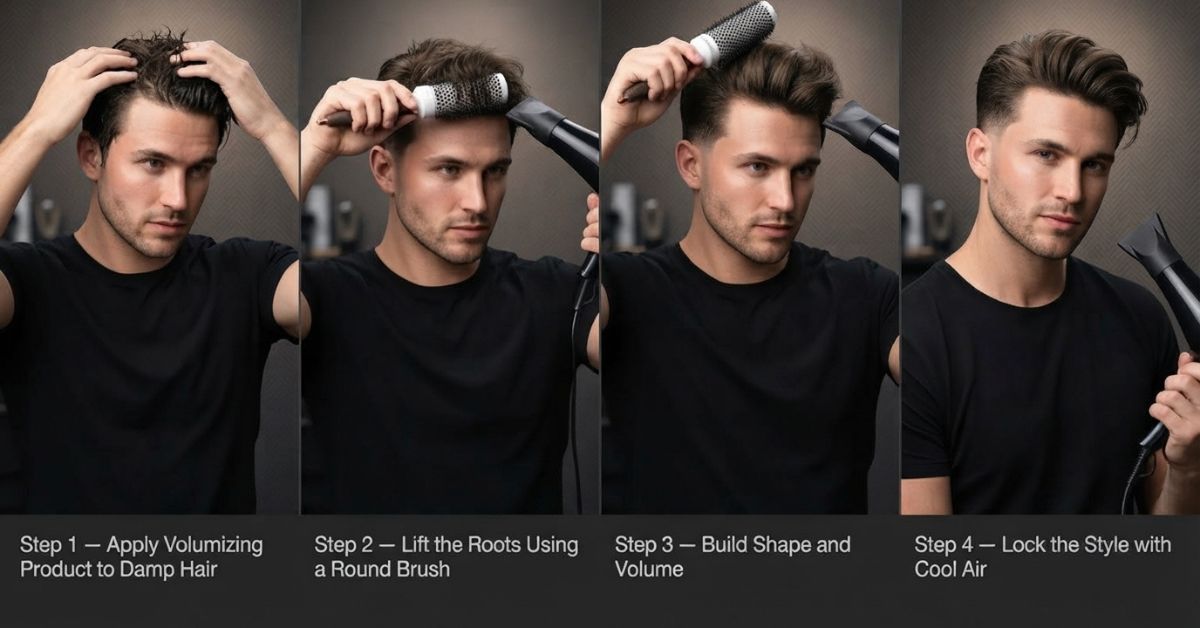
Getting the volume to hold comes down to five steps, done in this order:
- Apply a heat protectant to damp hair before using any hot tools
- Add a small amount of product matched to your hair type
- Blow-dry with a round brush (straight or wavy hair) or a diffuser (curly or coily hair), lifting at the roots
- Direct airflow forward and upward toward the crown
- Finish with a short burst of cool air to lock the shape in place
Which Product Matches Your Hair Type?
| Hair Type | Product | Common Mistake to Avoid |
|---|---|---|
| Straight | Volumizing mousse or texture powder | Heavy pomade, which flattens lift |
| Wavy | Light curl cream | Overloading product and weighing down movement |
| Curly | Curl cream with a diffuser | Brushing dry hair, which breaks the curl pattern |
| Coily | Leave-in cream plus light-hold gel | Using a thin product with no grip |
Does Humidity Affect a High Blowout Taper?
Yes. High humidity causes blow-dried volume to collapse faster, sometimes within a few hours. A stronger-hold product and a midday touch-up with texture powder help the style last longer in humid climates, while dry conditions typically hold volume through the entire day with little extra effort.
What Mistakes Ruin a High Blowout Taper?
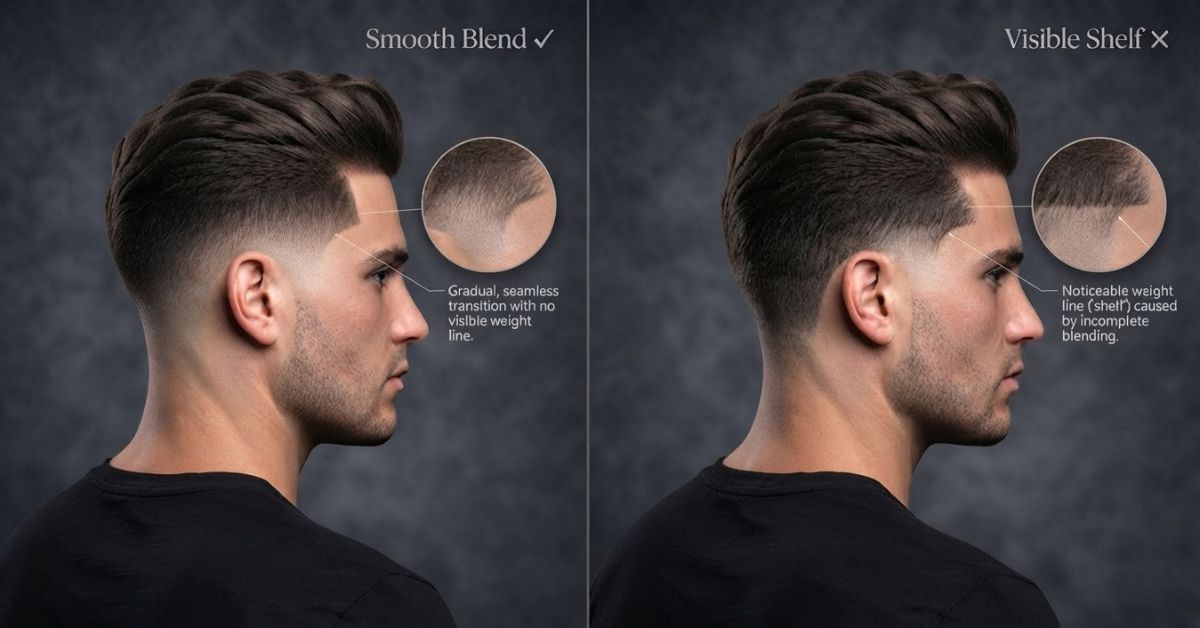
- Sides taken too high, creating a visible “shelf.” This happens when the transition zone isn’t blended. Ask specifically for a blended, not hard, transition next time.
- Top cut too short to blow out. This happens when less than two inches is left on top. Specify the exact top length before the cut begins.
- Flat, lifeless top after leaving the barbershop. This usually comes down to the wrong product for your texture. Match the product to the hair-type table above.
- Boxy, disconnected silhouette. This means the transition zone wasn’t properly faded. Request a seamless blend explicitly in your barber script.
- Volume that collapses within hours. This is caused by humidity or a skipped heat protectant step. Always apply heat protectant, and adjust your product for the climate you’re in.
How Often Does a High Blowout Taper Need a Trim?
A high blowout taper looks sharpest in the first week and starts losing definition by week three. A quick cleanup around the ten to fourteen day mark keeps the edges crisp, with a full cut every two to three weeks after that. This is noticeably more frequent than a low taper, which can often stretch to three or four weeks between visits since the lower contrast hides regrowth for longer.
If that schedule doesn’t realistically fit your routine, a mid or low taper gives a similar styled look with far less upkeep, and that’s not a downgrade, it’s simply a better match for how often you’re willing to sit in the chair.
Frequently Asked Questions About High Blowout Tapers
What is the difference between a high blowout taper and a high fade?
A high blowout taper leaves the top long enough to blow-dry into volume, while a high fade usually keeps the top short and textured, even though the fade height can be identical on both.
Can a high blowout taper work on curly or coily hair?
Yes, curly and coily hair naturally hold volume longer than straight hair, making them well-suited to this cut with the help of a diffuser and curl cream.
How long does hair need to be for a high blowout taper?
The top typically needs two to three inches of length, which takes most guys three to four months to grow out from a short fade.
Is a high blowout taper good for a round face?
Yes, it’s one of the most recommended cuts for round faces since the added height elongates facial proportions.
Does a high blowout taper work in a professional office setting?
It depends on the workplace. Conservative industries like finance or law usually suit a low or mid taper better, while creative and tech environments generally have more flexibility.
What should you tell your barber for a high blowout taper?
Ask for the fade to start above the temples, request a blended transition at the ears and neckline, and specify two to three inches of length on top.
Read More: Blowout Taper Textured Fringe – Low, Mid & High: What to Ask For and How to Style It
Key Takeaways
A high blowout taper delivers its best results when three things line up: your hair is long enough on top to hold real volume, your face shape benefits from the added height, and you’re genuinely willing to keep up with a trim every two to three weeks. Skip any one of those, and the cut can look flat, boxy, or grown-out far sooner than expected.
Walking into the barbershop with specific language, fade height, exact top length, and a request for a blended transition, is the single biggest factor in getting a sharp result the first time. If your face shape or schedule points toward less upkeep, a mid or low taper delivers a similarly styled look without the two-week commitment.

Marco Silva is a fashion writer and content creator at Faxhion Purly, sharing practical insights on clothing, styling, fashion trends, and personal style. With a focus on research and clear communication, Marco creates reader friendly articles designed to help fashion enthusiasts discover useful ideas, understand trends, and make informed style choices.