

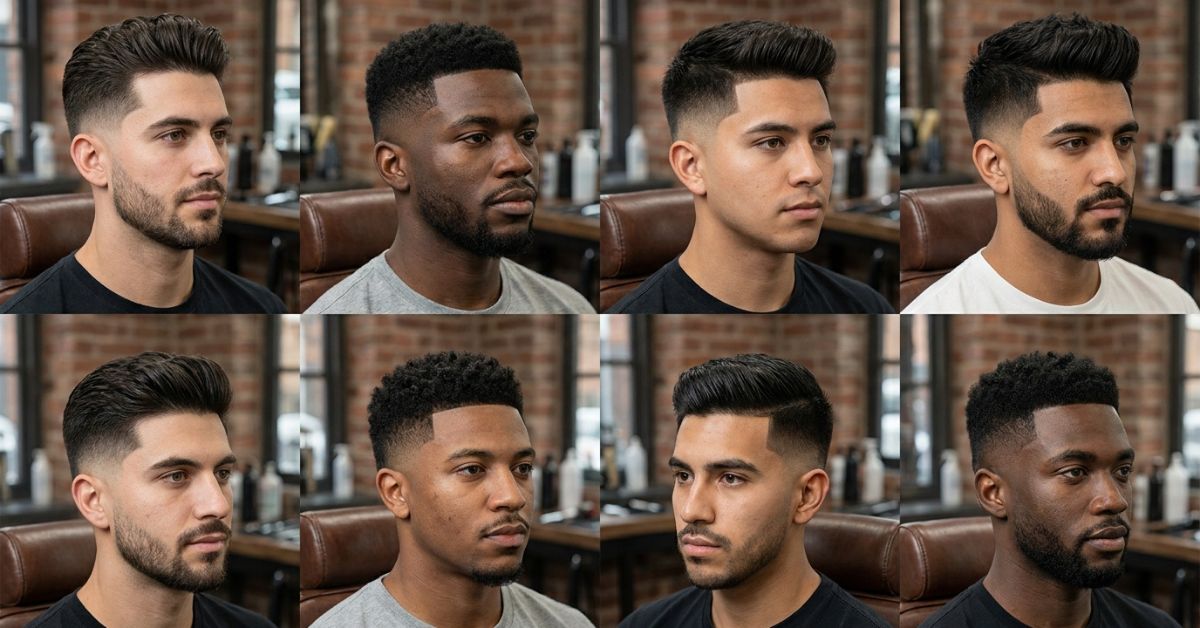
A taper fade is a men’s haircut in which the hair gets steadily shorter from the top down to the sides and neckline, giving a clean, sculpted finish. The three core types (low, mid, and high) differ in where the fade begins and where the blend sits. Beyond these, specialized variations such as the burst fade, drop fade, skin fade, shadow taper, and temple fade offer more distinctive looks.
This guide covers every major variation, how often each needs upkeep, which face shapes and hair textures suit it, how to explain it to your barber, and how to style it. It draws on the experience of a licensed master barber with 12 years of work on straight, wavy, curly, coily, and afro hair.
What Are the Main Taper Fade Types?
Taper fades fall into three main types, based on where the fade starts. A low taper begins just above the ears for a subtle, professional result. A mid taper starts roughly an inch higher for a balanced, modern look. A high taper begins near the temples for the strongest contrast and the boldest definition.
Key points:
- Low tapers are the most versatile and hold their shape for 3–4 weeks.
- Mid tapers strike the best balance between style and professionalism.
- High tapers give the sharpest contrast but need a touch-up every 1–2 weeks.
- Advanced variants include the skin fade, burst fade, drop fade, and shadow taper.
Quick Navigation: Types of Taper Fade at a Glance
Here is a side-by-side comparison to help you choose:
| Type | Fade Start Point | Best For | Maintenance | Formality Level |
|---|---|---|---|---|
| Low Taper Fade | Just above ears/nape | All face shapes, professional settings | 3–4 weeks | High |
| Mid Taper Fade | ~1 inch above ears | Balanced look, most versatile | 2–3 weeks | Medium-High |
| High Taper Fade | Near temples | Bold statement, angular faces | 2 weeks | Medium |
| Skin/Bald Fade | Razor to skin | Maximum contrast | 1–2 weeks | Medium-Low |
| Burst Taper | Arc behind the ear | Curly/thick hair | 2 weeks | Medium |
| Drop Fade | Curves down behind the ear | Natural head shape | 2–3 weeks | Medium |
| Shadow Taper | No skin exposure | Dense textures, subtle look | 3–4 weeks | High |
Use the table to match a style to how much upkeep you can manage and how formal your surroundings are. Next, each type in detail.
What Is a Taper Fade?
A taper fade is a men’s cut where the hair moves gradually from longer on top to shorter at the sides and neckline. It is built from two techniques. Tapering shortens the hair step by step as the barber works down the head. Fading blends the hair into even shorter lengths, sometimes right down to the skin. Together they leave length on top while the sides and back transition smoothly to very short hair.
Taper fades suit nearly every hair type, face shape, and personal style, whether your hair is straight, tightly curled, or an afro. Industry reports suggest they make up about 40% of men’s haircut requests in North America, which makes them the most requested fade variation.
The top usually stays between 1 and 4 inches, so you can slick it back, spike it, leave it curly, or keep it short and simple. The sides and back blend down from that length to the sideburns and neckline.
Taper vs. Fade: What’s the Difference?
People often mix these two up. A taper is a gradual reduction in length that respects your natural hairline and produces a subtle transition. It is conservative and grows out naturally.
A fade is more dramatic. It often runs all the way down to the skin, creating a stark contrast between the shortest and longest hair.
A taper fade blends the two: the smooth gradation of a taper with the closeness of a fade at the base. Every fade uses tapering, but not every taper is aggressive enough to count as a fade.
There is one more distinction. A taper fade concentrates on the sideburns and the nape, while a full fade wraps around the whole head. That makes the taper fade more versatile and more suitable for workplaces where a full skin fade might look too edgy.
The 3 Foundation Types of Taper Fade
Every taper fade starts from one of three foundation types, defined by where on the head the fade begins. Understanding these makes it easier to see how the other variations work.
Low Taper Fade
The low taper starts just above the ears and along the natural neckline, which makes it the subtlest and most professional option. The blend point, where the shortest hair meets the longer hair, sits about 1 to 2 inches up from the bottom of the hairline.
Key characteristics:
- Fade start point: Just above the ear line and nape
- Transition: The most gradual of all types, with a 2–3 inch blend zone
- Contrast level: Low to moderate
- Hair left on sides: More length than with mid or high fades
- Growth pattern: Grows out the most naturally, staying neat for 3–4 weeks
This is the most forgiving taper there is. Because the fade starts low, the transition still looks natural as the hair grows, and you won’t see harsh lines after two weeks as you might with higher fades.
Who should get a low taper fade:
Anyone can wear it, but it is especially good if you:
- Need a conservative haircut for work or school
- Have a round face (the subtle vertical lines help elongate it)
- Want a low-effort cut that lasts 3–4 weeks
- Prefer classic, timeless looks over trendy, bold ones
- Are trying a taper fade for the first time
It works on all hair types, straight, wavy, curly, or coily. The extra length at the sides keeps volume and texture, which matters most for curly or thick hair.
How to ask your barber:

“I’d like a low taper fade starting just above my ears. Keep the blend gradual with a natural taper at my neckline. Leave [your desired length] on top.”
Barbers typically blend clipper guards from a #1 or #2 at the base up to a #3 or #4 at the blend point.
Styling tips:
Little effort is needed. With straight hair, towel-dry and add a small amount of matte paste for light hold. For curly or wavy hair, work a curl-defining cream into damp hair and either air-dry or use a diffuser on low heat. You can practically wash and go, since the clean sides and back keep you looking polished with minimal work on top.
Mid Taper Fade
The mid taper begins about an inch above the ears and blends up toward eye level, landing between subtle and bold. It is the most versatile of the three, with clear definition but without the heavy upkeep of a high fade.
Key characteristics:
- Fade start point: About 1 inch above the ear line
- Transition: Moderate, with a 1.5–2 inch blend zone
- Contrast level: Medium, with a clearly visible fade line
- Defined line: A distinct meeting point between short and long sections
- Growth pattern: Stays sharp for 2–3 weeks before it needs a touch-up
The mid taper has more visual impact than a low one without going to extremes. People will notice the definition, yet it remains polished and appropriate in most settings.
Who should get a mid taper fade:
It is a good fit if you:
- Want a modern look that is still office-friendly
- Have an oval or square face (the balanced height flatters both)
- Have thick, straight hair or light waves
- Work in a creative or business-casual environment
- Like noticeable definition without dramatic contrast
Barber trend data indicates it is most popular with men aged 18 to 35 who want a contemporary style that stands out without looking aggressive.
How to ask your barber:
“I want a mid taper fade starting about an inch above my ears, fading up toward eye level. Blend it with a [#1, #2, etc.] at the base.”
Most barbers use a #0.5 or #1 guard at the base and blend up to a #2 or #3. The tighter gradient creates the defined line that makes this cut so appealing.
Styling tips:
Mid tapers go well with textured tops that need only light styling. Use molding paste for flexible hold on medium-length hair, or pomade for slicked-back looks. The defined line suits side parts, French crops, and textured fringes.
Plan on a barber visit every 2–3 weeks to keep the line crisp. At this height, grow-out shows up faster than it does with a low taper.
High Taper Fade
The high taper starts near the temples, roughly 2 inches from the hairline, and is the boldest and most dramatic version. It gives maximum contrast between the faded sides and the volume on top, which makes it a true statement cut.
Key characteristics:
- Fade start point: Near the temples, at or above eye level
- Transition: Rapid, with only a 1–1.5 inch blend zone
- Contrast level: High, with striking visual separation
- Exposure: A lot of scalp shows on the sides
- Growth pattern: Loses definition within 1–2 weeks, so frequent touch-ups are needed
High tapers are bold, edgy, and hard to miss. The high placement creates sharp vertical lines that frame the face and draw attention to whatever you do on top.
Who should get a high taper fade:
It works best if you:
- Have an angular face, strong jawline, or square face (the high placement softens sharp features)
- Have dark, thick hair, black or dark brown, which shows the most contrast
- Work in a creative or fashion-forward field
- Are between 16 and 30, the most common age range for this style
- Can commit to a barber visit every 1–2 weeks
Important consideration: High tapers look best on dark hair, where the contrast between the faded sides and longer top is most visible. On blonde, gray, or light brown hair, a high fade can look unintentionally bare rather than stylish.
How to ask your barber:
“I’d like a high taper fade starting near my temples. Take it down to a [#0, #0.5, or skin] at the base and blend it tight.”
Barbers often begin with a #0 guard, or go straight to skin at the base, then blend quickly up to a #1.5 or #2. The compact blend zone produces the high-contrast effect.
Styling tips:
High tapers pair best with shorter tops such as crew cuts, buzz cuts, or short textured crops. They also look great with tall pompadours and quiffs. Use firm-hold products like texture clay or a strong-hold pomade.
With this much exposed scalp, expect touch-ups every 10–14 days, so budget both time and money.
Advanced Technique Variants: Beyond Basic Height
Past the three standard heights, barbers use specialized techniques to produce distinct variations. These change the shape, contour, and finish of the fade, offering looks that go beyond simple height.
Skin Fade / Bald Fade Taper
A skin fade, also called a bald fade, tapers the hair down to bare scalp using a razor or bladeless clipper. It gives the highest contrast and the sharpest definition possible.
Key characteristics:
- Technique: The barber uses a razor or foil shaver at the base instead of standard clippers
- Result: Smooth, fully exposed scalp at the lowest point of the fade
- Contrast: Maximum, the most dramatic of all taper variations
- Maintenance: Every 7–10 days, since exposed skin shows stubble quickly
- Blend: Needs expert blending to avoid harsh lines between skin and hair
The abrupt shift from bare skin to full hair makes any top style stand out. That is why skin fades are often paired with designs, hard parts, or detailed line work, since the clean canvas shows detail well.
Best applications:
- Athletes and active people (the cooling effect and low styling effort are practical perks)
- Hair designs, hard parts, or artistic line work
- Dark, dense hair, which shows the most contrast
- Modern, fashion-forward styles
How to ask your barber:
“I want a [low/mid/high] skin fade; take it down to bare skin at the base with a razor finish.”
Burst Taper Fade
The burst taper features a semi-circular arc that radiates behind the ear like a sunburst. Rather than running straight from top to bottom as traditional tapers do, it curves around the ear and leaves length at the back of the neck.
Key characteristics:
- Shape: A semi-circle or arc centered behind the ear
- Back retention: Hair at the nape stays longer, giving natural flow or even a mullet effect
- Complexity: A challenging cut that calls for a skilled barber
- Best pairing: Medium to long hair on top, mohawks, faux hawks, and curly styles
- Grow-out: The arc grows out unevenly, so it needs upkeep about every 2 weeks
The burst fade originated in Black barbershop culture and remains popular in urban and hip-hop styling. It is distinctive, artistic, and makes a clear statement.
Best applications:
- Mohawks and faux hawks (the burst highlights the center strip)
- Curly and textured hair (it frames natural volume)
- Modern mullet styles (it preserves length at the nape)
How to ask your barber:
“I’d like a burst fade to create a semi-circle arc behind my ears and leave length at the back.”
Drop Fade Taper
A drop fade follows the natural curve of the head, with the fade line dipping lower behind the ear instead of running straight around. The result looks more organic and flowing, and it complements your natural head shape.
Key characteristics:
- Contour: The fade line curves downward, following the skull
- Arc: A visible “drop” behind the ear adds dimension
- Natural appearance: It tracks the occipital curve, the natural bump at the back of the head
- Versatility: Can be done as a low, mid, or high drop fade
- Subtlety: Less aggressive than straight horizontal fade lines
Visual distinction:
A traditional taper fade keeps a horizontal line around the head, while a drop fade makes a downward arc. Picture a line starting at the temple that, rather than going straight across to the back, gradually slopes down behind the ear before reaching the nape. It works with your head’s natural contour instead of against it.
Best applications:
- Men with a prominent occipital bone (a noticeable protrusion at the back of the head)
- Longer top styles such as slick backs or pompadours
- Anyone who wants a subtle, sophisticated fade with natural flow
How to ask your barber:
“I want a drop fade with the fade line curving down behind my ears, following my head shape.”
Shadow Taper Fade
The shadow taper creates gentle graduation without exposing any skin, for a soft, natural finish. Rather than blending down to a #0 guard or a razor finish, the shortest point stays at a #1 or #2, producing a “shadow” effect.
Key characteristics:
- Shortest length: #1 or #2 guard (never down to skin)
- Contrast: Minimal, the subtlest of all fade types
- Blend: Extremely gradual and barely noticeable
- Professional appeal: Well suited to conservative settings
- Longevity: Lasts 3–4 weeks before looking overgrown
Shadow tapers suit anyone who wants the structure and clean lines of a fade without dramatic exposure. They look refined and mature, and fit even the most conservative workplaces.
Best applications:
- Dense, coarse hair such as afros, tight curls, or thick straight hair
- Corporate settings like law, finance, medicine, and education
- Mature men aged 35 and up who want a refined look
- Anyone with a sensitive scalp who wants to avoid razor irritation
How to ask your barber:
“I want a shadow taper fade. Blend it gradually but don’t take it down to skin. Keep the shortest section at a #1 or #2.”
Temple Fade (Brooklyn Fade)
A temple fade, also known as a Brooklyn fade or temp fade, limits the taper to the temple area and the nape, leaving the hair over and behind the ears at full length. This creates a distinctive frame around the face.
Key characteristics:
- Location: Only the temples and nape are tapered; the sides stay long
- Frame effect: Sharp angles at the temples frame the face
- Cultural roots: Popular in Black barbershop culture and hip-hop styling
- Versatility: Works with short or long hair on top
- Maintenance: Every 2–3 weeks, since temples grow out quickly
Temple fades are about adding definition where it counts, around the face, while keeping volume and texture everywhere else. That makes them ideal for natural styles that depend on side volume.
Best applications:
- Afros and natural textured styles
- Box fades and flat tops
- Tight curls and coils (they preserve crucial side volume)
- Looks where you want facial framing without removing overall bulk
How to ask your barber:
“I want a temple fade. Just fade the temples and nape, and keep the length over my ears.”
Taper Fade Styles by Hair Type & Texture
Your natural texture strongly affects which taper works best and how it should be cut. Here is how to match a taper fade to your hair.
Taper Fade for Curly Hair
Curly hair and taper fades work especially well together, because tight, voluminous curls on top contrast naturally with clean faded sides. The aim is a fade height that shows off your curl pattern without removing too much weight.
Key considerations:
- Best fade types: Low to mid taper, which preserves curl weight and volume
- Top length: At least 2–4 inches, so curls can form properly
- Blend approach: Gradual blending avoids harsh lines that clash with curl texture
- Maintenance: Every 3–4 weeks, since curls hide grow-out better than straight hair
- Common mistake: Cutting curls too short on top creates an unflattering mushroom shape
Styling guidance:

Apply curl-defining cream to damp hair, scrunching from ends to roots. Never brush or comb dry curls; finger-comb only. Air-dry or use a diffuser on low heat. The taper takes weight off the sides, so the curls on top spring up with natural volume.
Between washes, refresh with a light mist of water and leave-in conditioner to reactivate the curl pattern without a full wash.
Product recommendations:
- Curl-defining cream (medium hold)
- Leave-in conditioner (for moisture)
- Lightweight gel (optional, for extra hold)
Taper Fade for Straight Hair
Straight hair shows a taper fade most clearly, since no curl pattern softens the lines. It works with any fade height and gives the cleanest, sharpest contrast, but grow-out also shows faster than with textured hair.
Key considerations:
- Best fade types: All work, though mid and high fades show the best definition
- Top length: Flexible, from buzz cuts to 4+ inches
- Blend approach: Clean, defined lines look excellent on straight texture
- Maintenance: Every 2–3 weeks, since grow-out is very visible
- Styling versatility: Side parts, slick backs, pompadours, and French crops all suit it
Styling guidance:
Straight hair offers the most styling freedom. Blow-dry the top while brushing in the direction you want to add volume and shape. Use pomade for slicked styles, matte clay for a textured look, or sea salt spray for natural movement. With the right product, straight hair holds its shape through the day.
Product recommendations:
- Pomade (slicked styles with shine)
- Matte clay (textured, natural-looking styles)
- Sea salt spray (natural volume and movement)
Taper Fade for Afro Hair
Afro-textured hair with a taper fade is one of the most iconic combinations in barbering. The contrast between a rounded, full afro and precisely faded sides is both timeless and modern. It does, however, call for specialized cutting technique and an experienced barber.
Key considerations:
- Best fade types: Low to mid taper, shadow fades, and temple fades, which preserve natural texture
- Technique requirement: The barber must understand coily hair structure and the right cutting angles
- Shape focus: Keeping a rounded afro silhouette while cleaning up the edges
- Maintenance: Every 2–3 weeks to hold the fade shape, longer if you are growing out the afro
- Cultural significance: Rooted in Black barbershop tradition and style evolution
Styling guidance:
Keep hair moisturized daily with a leave-in conditioner or curl cream. Pick out the afro to shape it, and avoid brushes, which can damage the curl pattern. Keep the faded sides tidy with regular touch-ups. Many men add an edge-up (sharp hairline definition) for extra contrast and precision.
Taper Fade for Asian Hair
Asian hair is typically straight, thick, and coarse, with a round follicle shape. It grows strong and straight and holds a shape well, but it can look heavy without proper tapering. A taper fade removes bulk while keeping the clean, structured look this hair naturally has.
Key considerations:
- Hair properties: Thicker strands, straight growth, dense coverage
- Best fade types: Low to mid taper, which controls bulk without over-thinning
- Common styles: French crops, textured fringes, side parts, and slick backs
- Stubborn growth: Hair often grows straight out rather than lying flat, so the cut needs to be planned around it
- Maintenance: Every 3–4 weeks, since thick density hides grow-out well
Styling guidance:
This hair holds styles very well. Use a blow-dryer to direct the growth pattern while the hair is damp. Matte paste or clay suits textured looks, and pomade suits slicked ones. Thick hair often needs less product than guides suggest, so start with a small amount and add more only if needed.
Frequently Asked Questions
1. What are the 3 main types of taper fade?
The three main types are low, mid, and high, defined by where the fade starts. A low taper begins just above the ears (3–4 weeks between cuts), a mid taper begins about 1 inch above the ears (2–3 weeks), and a high taper begins near the temples (1–2 weeks).
2. Which taper fade is best for beginners?
The low taper is the best choice for beginners. It is the subtlest, lasts 3–4 weeks between cuts, suits all face shapes and hair types, and is appropriate anywhere.
3. How often do you need to cut a taper fade?
Low tapers last 3–4 weeks, mid tapers 2–3 weeks, and high or skin fades 1–2 weeks. Your hair’s growth speed and texture (curly vs. straight) also affect how often you need a cut.
4. What’s the difference between a taper and a taper fade?
A taper is a gradual reduction in length that stops around a #2–#3 guard. A taper fade is more aggressive, going down to #0 or skin. Taper fades give dramatic contrast, while tapers stay subtle.
5. Can you get a taper fade with curly hair?
Yes, curly hair works very well with taper fades. Choose a low to mid taper to preserve curl volume, and ask your barber to cut your curls dry rather than wet.
6. What face shape suits a high taper fade?
High tapers suit angular faces, square jaws, and round faces. Avoid it if you have a long face or a receding hairline. It looks best on dark hair, where the contrast is greatest.
7. Is a taper fade professional enough for work?
Yes, low and mid tapers are professional in corporate environments. Low tapers suit conservative fields like law and finance, while mid tapers suit business-casual and creative settings.
8. What should I tell my barber for a taper fade?
Specify the fade height, the length at the base, and the length on top. For example: “Low taper fade starting above my ears, blended to a #1, with 3 inches on top.” Bring reference photos.
9. How do you maintain a taper fade at home?
Between barber visits, trim the neckline and sideburns with a trimmer using the same guard length. Don’t try to recreate the fade blend yourself; only touch up the edges.
10. Does hair type matter for taper fades?
Yes, it matters a lot. Curly hair suits low to mid tapers, thick hair benefits from mid to high fades, thin hair needs low tapers, and afro-textured hair calls for a barber with specialized expertise.

Marco Silva is a fashion writer and content creator at Faxhion Purly, sharing practical insights on clothing, styling, fashion trends, and personal style. With a focus on research and clear communication, Marco creates reader friendly articles designed to help fashion enthusiasts discover useful ideas, understand trends, and make informed style choices.