

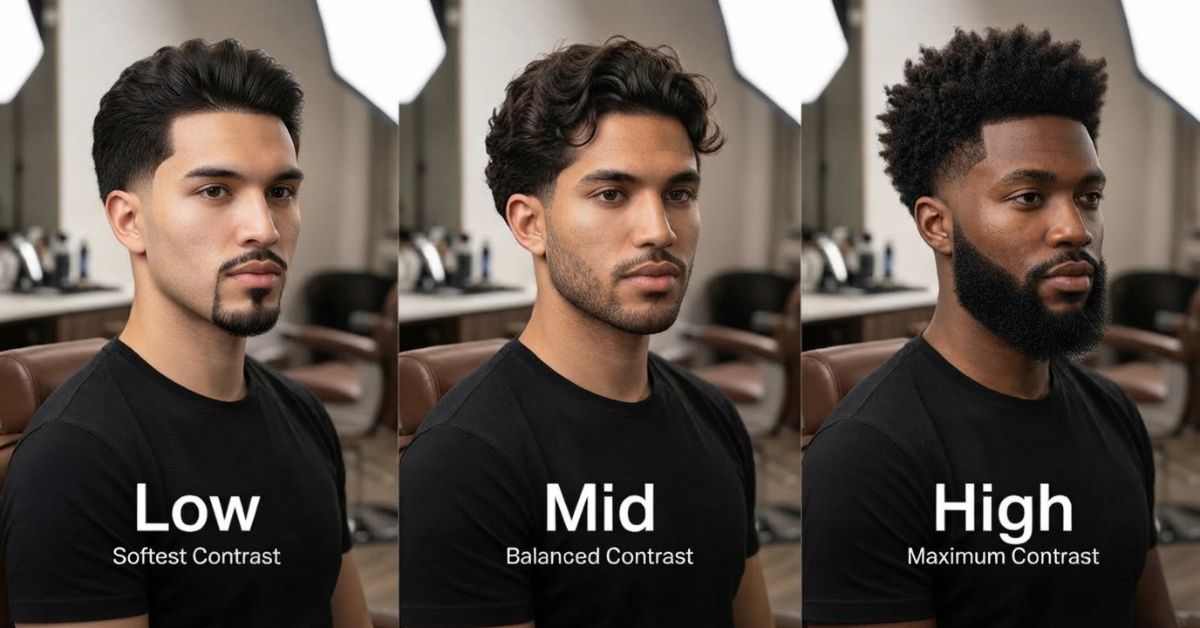
A blowout taper fade is one of the few men’s haircuts that works in a boardroom on Monday and a rooftop bar on Friday. It pairs a clean, gradual taper on the sides with a lifted, voluminous top, and in 2026 it remains one of the most requested cuts at barbershops because it adapts to almost any hair type, texture, and face shape. This guide breaks down all 35 variations, matches the cut to your specific hair, and gives you word-for-word scripts so you walk out of the chair with exactly what you pictured.
What is a blowout taper fade?
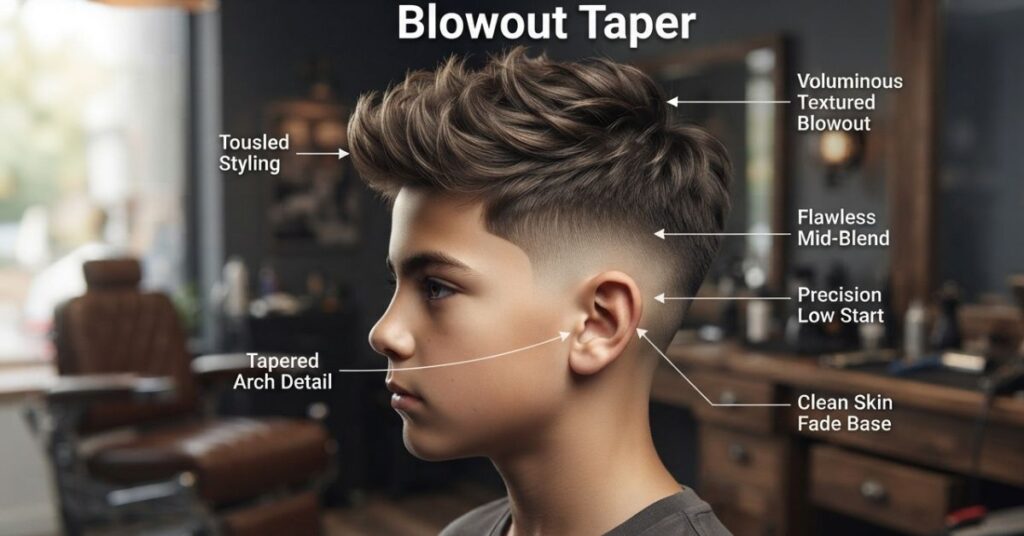
A blowout taper fade is a men’s haircut that combines a gradually shortened taper on the sides and back with long, voluminous hair on top that is blow-dried upward and outward for height and lift. The sides taper smoothly from skin or short guard lengths near the neckline into longer hair, while the crown stays full enough to be styled into a lifted, textured shape.
The result is a cut with sharp, defined edges around the ears and neckline that contrasts against a soft, lifted crown. This contrast is what makes the style so flexible. A barber can dial the taper up or down for a subtler or bolder look, and the top can be styled sleek, messy, curly, or spiked depending on the occasion and hair texture.
Historically, the temple fade and blowout trace back to late 1990s and early 2000s barbershop culture, and the look has cycled back into mainstream popularity multiple times since, most recently driven by athletes, musicians, and social media barbers showcasing longer, textured tops paired with tight fades. In 2026, the trend has matured past a single signature look into dozens of variations, which is why knowing the right terminology matters before you sit in the chair.
Key Points
- A blowout taper fade blends a low, mid, or high taper with 3 to 6 inches of styled volume on top.
- It differs from a standard taper fade mainly in top length and the upward, blown-out finish.
- It suits straight, wavy, curly, and coily hair, though styling technique changes by texture.
- Most versions need a trim every 2 to 4 weeks to keep the fade line sharp.
- You can request it using a simple 4-part barber script covering fade height, guard number, top length, and finish.
35 Blowout Taper Fade Variations
Below are 35 real variations organized by where the fade starts on the head, plus a specialty group for texture, color, and added detail. Use these names directly with your barber for the clearest results.
Low Taper Blowout Variations
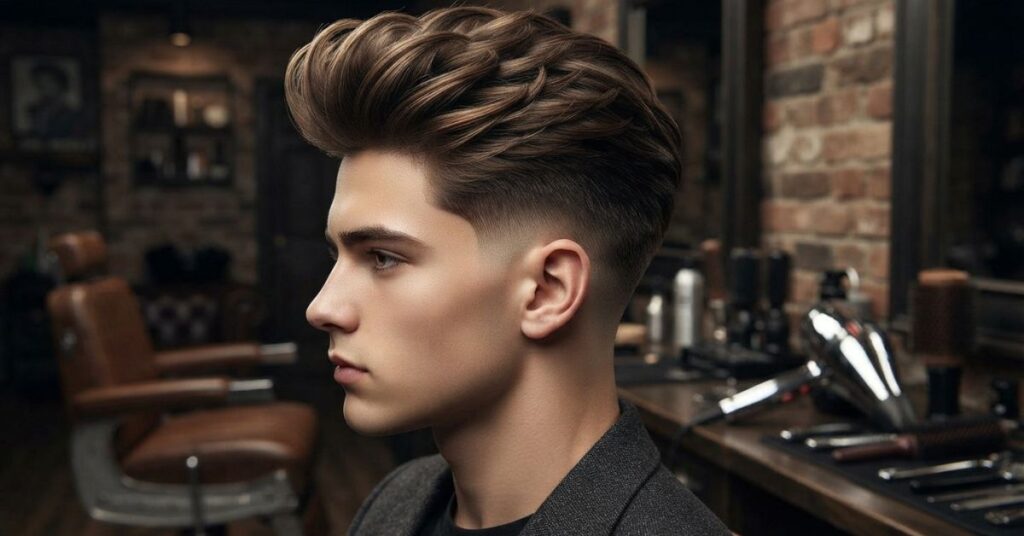
- Classic low taper blowout, fade starts just above the ear
- Low taper blowout with a hard part
- Low drop fade blowout, curves down behind the ear
- Low taper blowout with textured fringe
- Low taper blowout undercut
- Low taper blowout with skin line at the neckline
- Low taper blowout with beard fade
- Low taper blowout with natural curls on top
- Low taper blowout with side-swept crown
Mid Taper Blowout Variations

- Classic mid taper blowout, fade starts at the temple
- Mid taper blowout with volume swept straight back
- Mid taper blowout with a defined side part
- Mid taper blowout with textured crop on top
- Mid taper blowout with wavy top
- Mid taper blowout with disconnected fringe
- Mid taper blowout with faded sideburns
- Mid taper blowout with brushed-up quiff
- Mid taper blowout with subtle highlights
High Taper Blowout Variations
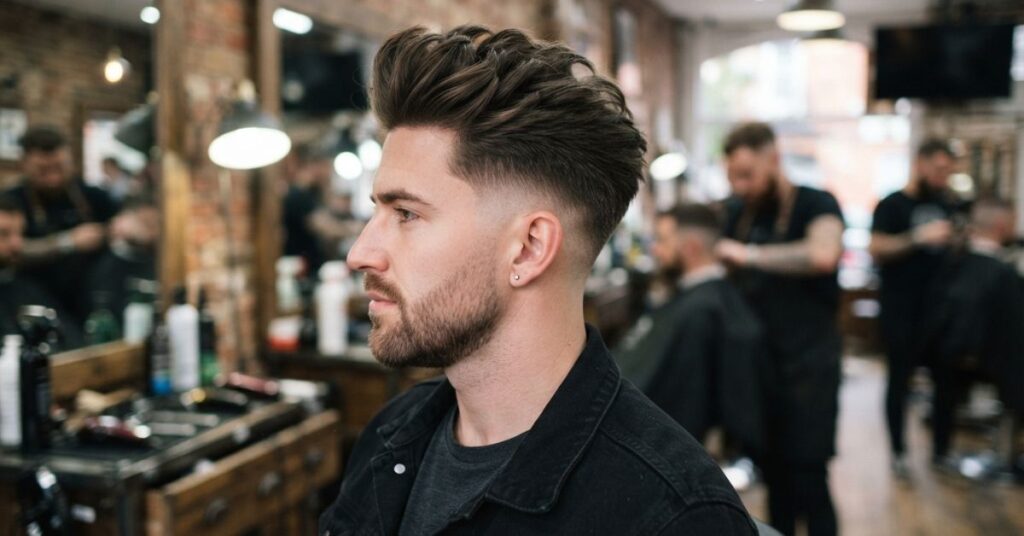
- Classic high taper blowout, fade starts near the crown
- High taper blowout with spiky top
- High taper blowout with pompadour styling
- High taper blowout with slicked-back finish
- High taper blowout with curly volume
- High taper blowout with a hard side part
- High taper blowout with buzzed sides and long top
- High taper blowout with faux hawk shaping
- High taper blowout with skin fade contrast
Specialty Blowout Taper Variations

- Blowout taper perm, adds curl definition to the top
- Blowout taper fringe, blunt fringe with lifted crown
- Burst fade blowout, curved fade around the ear only
- Temple fade blowout, tight taper at the temples only
- Blowout taper with design lines shaved into the fade
- Blowout taper with two-tone color on top
- Blowout taper mullet, longer back paired with a tapered fade
- Blowout taper afro, natural coily volume on top with a tight taper
Which Blowout Taper Fade Suits Your Hair?

Not every variation above looks the same on every hair type. The fade itself works on any texture, but the top section behaves very differently depending on whether your hair is straight, wavy, curly, or coily.
Straight Hair
Straight hair holds volume the least naturally, so a blowout taper fade on straight strands relies almost entirely on blow-drying technique. Ask for at least 3 to 5 inches on top so there is enough weight and length for a round brush to create lift. Straight hair also shows a sharp taper line more clearly, so a crisp mid or low taper tends to look cleanest.
Curly Hair
Curly hair naturally provides volume, which makes the blowout look fuller with less daily effort. A low taper blowout curly hair style is one of the most requested combinations because the curls create contrast against the tight sides without needing much product. Diffusing rather than blow-drying straight usually preserves curl pattern better.
Wavy Hair
Wavy hair sits between straight and curly, giving natural texture without the need for aggressive round-brush work. A mid taper blowout on wavy hair often looks best with a sea salt spray for texture rather than heavy pomade, since wavy hair can go greasy-looking fast with too much product.
Afro-Textured or Coily Hair
On afro-textured or coily hair, the blowout taper fade takes on a different shape entirely. Instead of a blown-out, lifted crown, the top is typically left as natural coily volume with a tight, precise taper around the perimeter. This version relies on a barber skilled in cutting curl patterns evenly, since coily hair shrinks significantly once cut.
Fine or Thin Hair
Fine or thin hair struggles to hold the blowout shape for long, so barbers often recommend keeping the top slightly shorter, closer to 3 inches, and using a lightweight volumizing spray rather than heavy wax, which can weigh fine strands down and collapse the lift.
Read More : Low Taper Fade Wavy Hair: 25 Best Styles (2026 Guide)
Choosing by Hair Density
Hair density, not just texture, determines how bold a blowout you can pull off. Thick, dense hair supports higher and more dramatic volume, which is why mid and high taper blowouts with tall crowns are usually reserved for thicker hair types. Thinner density hair generally looks more polished with a low taper and a softer, less exaggerated top.
What Face Shape Suits This Cut?
Face shape changes which taper height and top volume flatter you most.
- Round faces benefit from height on top and a higher taper, which elongates the face visually.
- Square faces pair well with almost any taper height since strong jawlines balance most top volumes, though a mid taper with softer, textured styling avoids adding too much bulk.
- Oval faces can wear nearly every variation on this list, making them the most flexible face shape for a blowout taper fade.
- Long faces look best with a low taper and a top that is styled more forward or side-swept than straight up, which avoids adding extra vertical length.
- Heart-shaped faces suit a low or mid taper with fuller sides near the temple to balance a narrower chin.
How Long Does Your Hair Need to Be?
Most blowout taper fades require at least 3 to 5 inches of length on top to achieve real height and lift when styled. Anything shorter than 3 inches tends to look more like a textured crop than a true blowout, since a round brush needs enough length to grip and lift the hair. If you are starting from a very short cut, expect to grow the top out for roughly 3 to 5 months before you have enough length for the full blown-out effect, while the sides can be tapered on your regular trim schedule the entire time.
How Do You Ask Your Barber?

Clear communication is the single biggest factor separating a great blowout taper fade from a disappointing one. Barbers cannot read your mind, and vague requests like “just a fade” leave far too much room for interpretation.
The 4-Part Barber Script
Use this exact structure every time you sit in the chair:
- State the fade height. “I want a low taper fade” or “mid taper” or “high taper.”
- Give the guard number for the sides. For example, “Start with a number 2 guard at the bottom, blending up to a 4 near the top of the fade.”
- Specify the top length. “Leave 4 inches on top, cut with scissors, not clippers, so there’s enough weight for volume.”
- Describe the finish. “Style it blown out and lifted, not slicked down or flat.”
Scripts for Each Variation
- Low taper blowout: “Low taper fade starting just above my ear, blend into 4 to 5 inches on top styled up and back.”
- Mid taper blowout: “Mid taper fade starting at my temple, keep the crown full with about 4 inches, blown out for height.”
- High taper blowout: “High taper fade close to the crown, sharp contrast with the top, style it lifted with a matte product.”
- Curly top blowout: “Low taper fade, leave my curls natural on top around 4 inches, don’t blow-dry straight, diffuse instead.”
- Textured fringe blowout: “Mid taper fade with a disconnected fringe on top, textured not blunt, styled forward and lifted.”
Common Client Mistakes to Avoid
- Saying “short on the sides” without naming a taper height or guard number.
- Forgetting to specify scissor cutting on top, which can result in the barber taking off too much weight with clippers.
- Not bringing a reference photo, since barbers interpret terms like “voluminous” differently.
- Asking for a fade when you actually want a softer taper, which produces a much sharper, more dramatic result than intended.
- Skipping the finish instruction, leaving the barber to guess whether you want it styled up or left natural.
How Do You Style It at Home?
- Start with clean, towel-dried hair that is still slightly damp.
- Apply a lightweight volumizing spray or sea salt spray at the roots, focusing on the crown.
- Blow-dry the top section upward and back using a round brush, lifting at the roots as you go.
- Once fully dry, work a small amount of matte paste or clay through the ends for texture and hold without shine.
- Use your fingers rather than a comb for the final shaping to keep the style looking natural rather than overly polished.
- On curly or coily hair, replace the round brush step with a diffuser attachment set to low heat to preserve curl definition.
How Often Do You Need a Trim?
Because the taper is what defines this haircut, it needs more frequent maintenance than a simple long-on-top style. Most people need a trim every 2 to 3 weeks to keep a low or mid taper crisp, and every 1 to 2 weeks for a high taper, since higher fades grow out and lose their sharp line faster. The top section, by contrast, can often go 6 to 8 weeks between trims since length is the goal there rather than precision.
What Does Grow-Out Look Like?
In the first week after a cut, the fade line stays crisp and the contrast between sides and top is at its sharpest. By weeks 3 to 4, the taper line softens and starts blending upward, which many people actually like for a slightly more relaxed, natural look. Past week 5 or 6, the fade typically loses its defined shape entirely and starts looking more like an uneven, overgrown taper, which is the point most barbers recommend booking your next appointment.
How Is It Different From a Taper Fade?

A standard taper fade and a blowout taper fade share the same side and back technique, but they differ significantly on top. A classic taper fade usually keeps the top around 1 to 3 inches, styled flat, textured, or with light natural movement. A blowout taper fade extends that top length to 3 to 6 inches and adds a directional, upward blow-dried finish for volume and height. In short, every blowout taper fade includes a taper fade, but not every taper fade includes a blowout.
Is It Still Trending in 2026?
Yes, the blowout taper fade remains one of the most searched and requested men’s haircuts heading into 2026, driven largely by barbershop content on social platforms and its proven versatility across hair types. Its staying power comes from how easily it moves between low-maintenance and high-styling looks depending on how much time someone wants to spend with a blow dryer, which keeps it relevant for both minimalist and maximalist grooming routines.
Frequently Asked Questions
Does a blowout taper fade work on short hair?
Not fully. You need roughly 3 inches of length on top for the classic lifted, blown-out effect to hold.
How much does a blowout taper fade cost?
Prices typically range from $25 to $60 depending on your barber’s experience and whether styling is included.
Can women get a blowout taper fade?
Yes, the cut has become popular among women too, especially paired with longer curly or coily tops.
What products work best for styling?
A lightweight volumizing spray for lift plus a matte paste or clay for texture and hold without shine.
Is a blowout taper fade high maintenance?
The sides need trims every 2 to 3 weeks, but daily styling only takes about 5 minutes with practice.
Does this cut suit thinning hair?
Yes, a low taper with a shorter top around 3 inches and a lightweight product avoids weighing thinning hair down.
What is the difference between a low, mid, and high taper blowout?
The difference is where the fade begins on the head, near the ear, at the temple, or near the crown, with height increasing the contrast.
Can curly hair get the blowout effect without heat damage?
Yes, using a diffuser on low heat with a heat protectant preserves curl pattern while still adding lift and volume.
Read More : 50 Best Low Fade Side Design Taper for Men: Back, Side & Freestyle Ideas (2026)
Key Takeaways
- A blowout taper fade combines a tapered side and back with a voluminous, blown-out top, and it works across straight, wavy, curly, and coily hair with adjusted styling technique.
- There are 35 practical variations across low, mid, high, and specialty categories, giving you specific terms to use rather than vague descriptions.
- Face shape and hair density should guide your taper height and top volume choice for the most flattering result.
- A clear, 4-part barber script covering fade height, guard number, top length, and finish removes almost all guesswork from your next appointment.
- Regular trims every 1 to 3 weeks keep the fade sharp, while the top can grow for months to build the length needed for a dramatic blowout.

Marco Silva is a fashion writer and content creator at Faxhion Purly, sharing practical insights on clothing, styling, fashion trends, and personal style. With a focus on research and clear communication, Marco creates reader friendly articles designed to help fashion enthusiasts discover useful ideas, understand trends, and make informed style choices.